The host creates a private room, shares the room code, and starts once at least two playable seats are present.
Player ruleset
Complete Rules
Everything a table needs to host, join, choose cards, resolve effects, and finish a match without a live rules explainer.
At a glance
Quick Start
Each standoff costs the losers one life. The match ends when one player has lives left, or everyone remaining loses their last life together.
The host can change starting lives and choose Sets 1–6 or Random before the game starts.
Each player owns seven physical cards: bullets 1 through 6, plus Reload 0. In a round, each living player secretly chooses one available card. Cards reveal together, resolve from 6 down to 0, then the shootout happens.
The important rhythm is simple: high cards get earlier effects, low values are dangerous at the end, and Reload gives ammo back but does not save you from being shot.
Every round
Round Flow
- 1. Choose
Every living player secretly selects one available card. Dead players sit out until the next standoff. If you have no bullets left, you must choose Reload.
- 2. Reveal
After every living player submits, all selected cards reveal at the same time. Before reveal, opponents can only see that you submitted.
- 3. Resolve Effects
Cards resolve by printed priority from 6 down to 0. Some effects are automatic. Some pause the table while the acting player chooses from legal targets shown by the game.
- 4. Shoot
Protected cards are ignored first. Normally, every unprotected card tied for the lowest current shootout value is shot.
- 5. Cleanup
Shot players die for the rest of the standoff. Played bullets become spent unless their owner successfully Reloaded. Reload itself never becomes spent.
- 6. Continue
If at least two players are still alive, play another round. If one or zero players remain, the standoff ends and the losers each lose one life.
Shared rules
Core Rules
Standoffs and Lives
A standoff is a sequence of rounds. When a standoff ends with exactly one survivor, every other active player loses 1 life. When nobody survives, every active player loses 1 life. Players at 0 lives are eliminated from the match.
Ammunition
Played bullets normally become spent at cleanup and stay spent across later rounds and standoffs. A successful Reload restores all six of the reloading player's own bullets, including bullets played that same round.
Printed Priority
Printed priority is the physical card's identity. It controls card name, ownership, activation timing, and duplicate checks. It does not change when a card moves or when its current value changes.
Current Shootout Value
Current shootout value is used only when deciding who is shot. It starts equal to printed priority at reveal, can be changed by effects, and resets after cleanup.
Decisions
Some cards require a choice after reveal. The game pauses for the acting player and highlights legal targets. Only that player can submit the decision.
Protection
Protection applies to a physical active card and only matters during shooting. A protected card can still be moved, changed, cancelled, or affected by other card effects unless a card says otherwise.
Reload gives no shooting protection.
Reload restores ammunition, but if its current value is the lowest unprotected value at shooting, the reloading player is shot.
All playable variants
Card Set Reference
Set 1 Classic standoffSet 2 Punishment and recoverySet 3 Permanent exchangeSet 4 Current valueSet 5 Discard and retrievalSet 6 Blood Money
Card set
Set 1: Classic standoff
The default set. It centers on temporary swaps, value changes, duplicate cancellation, and risky Reload timing.
- Duplicates
- Printed priorities 6, 5, 4, 3, and 2 cancel their own effects when two or more physical cards of that priority are revealed. Physical 1s and 0s do not cancel. Duplicates do not kill players by themselves and do not replace the normal shooting rule.
- Ownership
- Swaps are temporary. Physical cards return to their original owners during cleanup, and original ownership decides which bullets become available or spent.
- Shooting
- After all effects resolve, remove protected cards. The lowest remaining shootout value is shot. Ties for lowest are all shot. If every card is protected, nobody is shot.
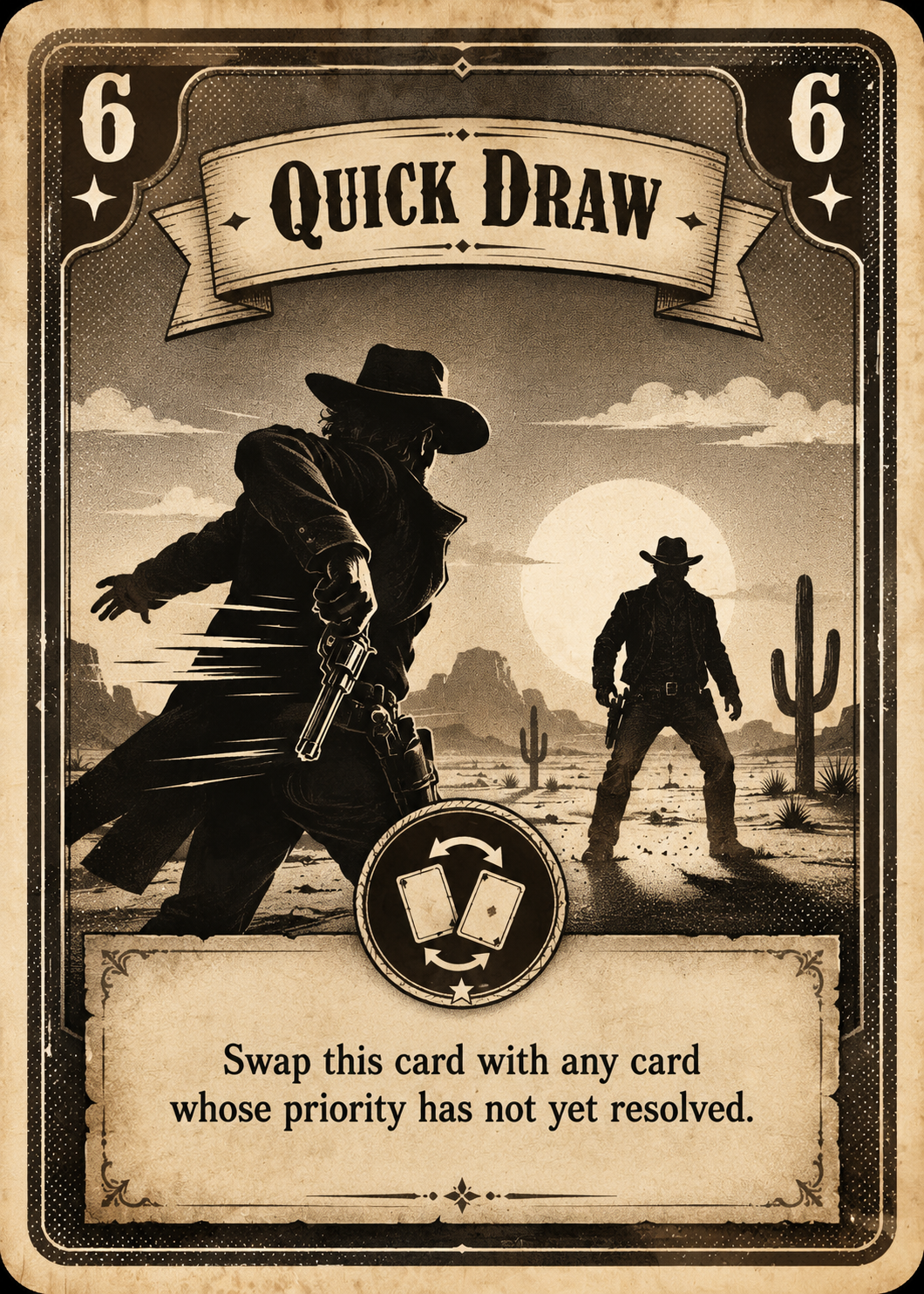
Priority 6
Quick Draw
First post-reveal decision
If it is the only physical 6 in play, choose one unresolved lower-priority card and swap physical cards with it.
- Legal targets are normally priorities 5, 4, 3, 2, 1, or 0.
- The 6 is already resolved after the swap and never activates again this round.
- The lower card you receive may still activate later if its priority has not resolved.
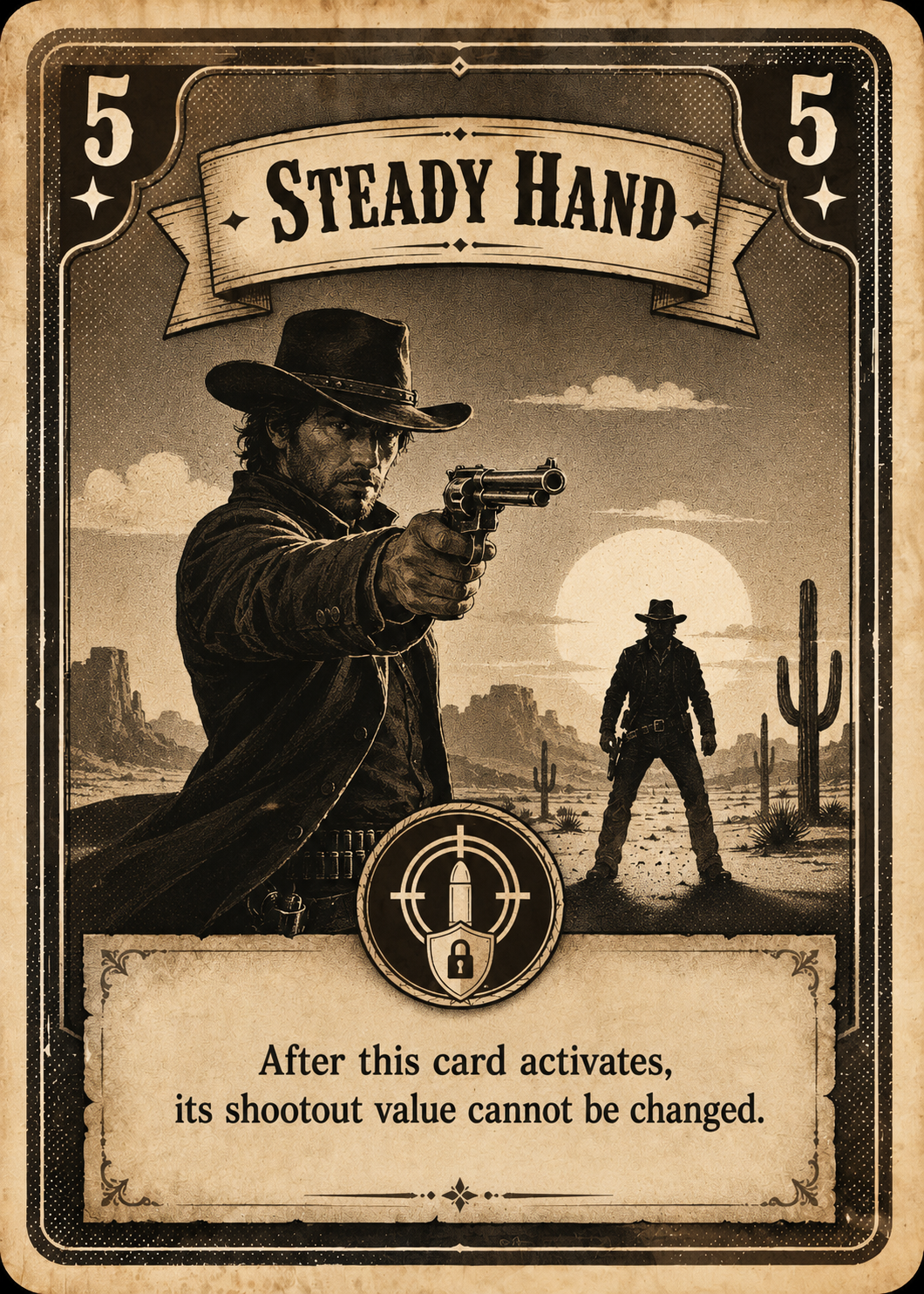
Priority 5
Steady Hand
High value with protection from value changes
If it activates uniquely, lock this card's shootout value for the rest of the round.
- A locked 5 cannot be changed by Take You With Me.
- Duplicated 5s cancel and do not get the lock.
- The lock follows the physical card if it is swapped.
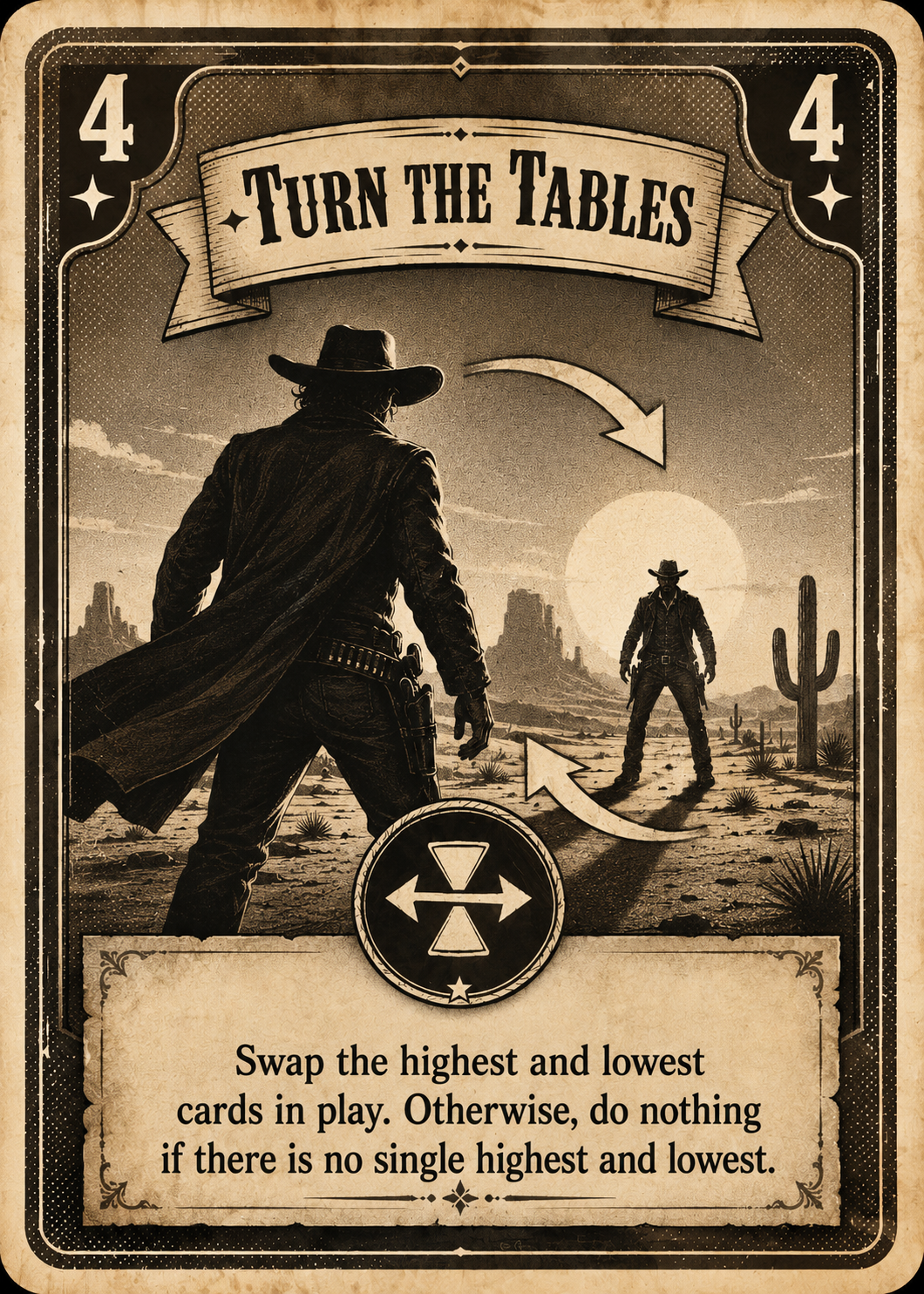
Priority 4
Turn the Tables
Automatic board reversal
If it activates uniquely, automatically swap the physical cards with the unique highest and unique lowest current shootout values.
- If the highest value is tied, nothing happens.
- If the lowest value is tied, nothing happens.
- Players do not choose among tied extremes.
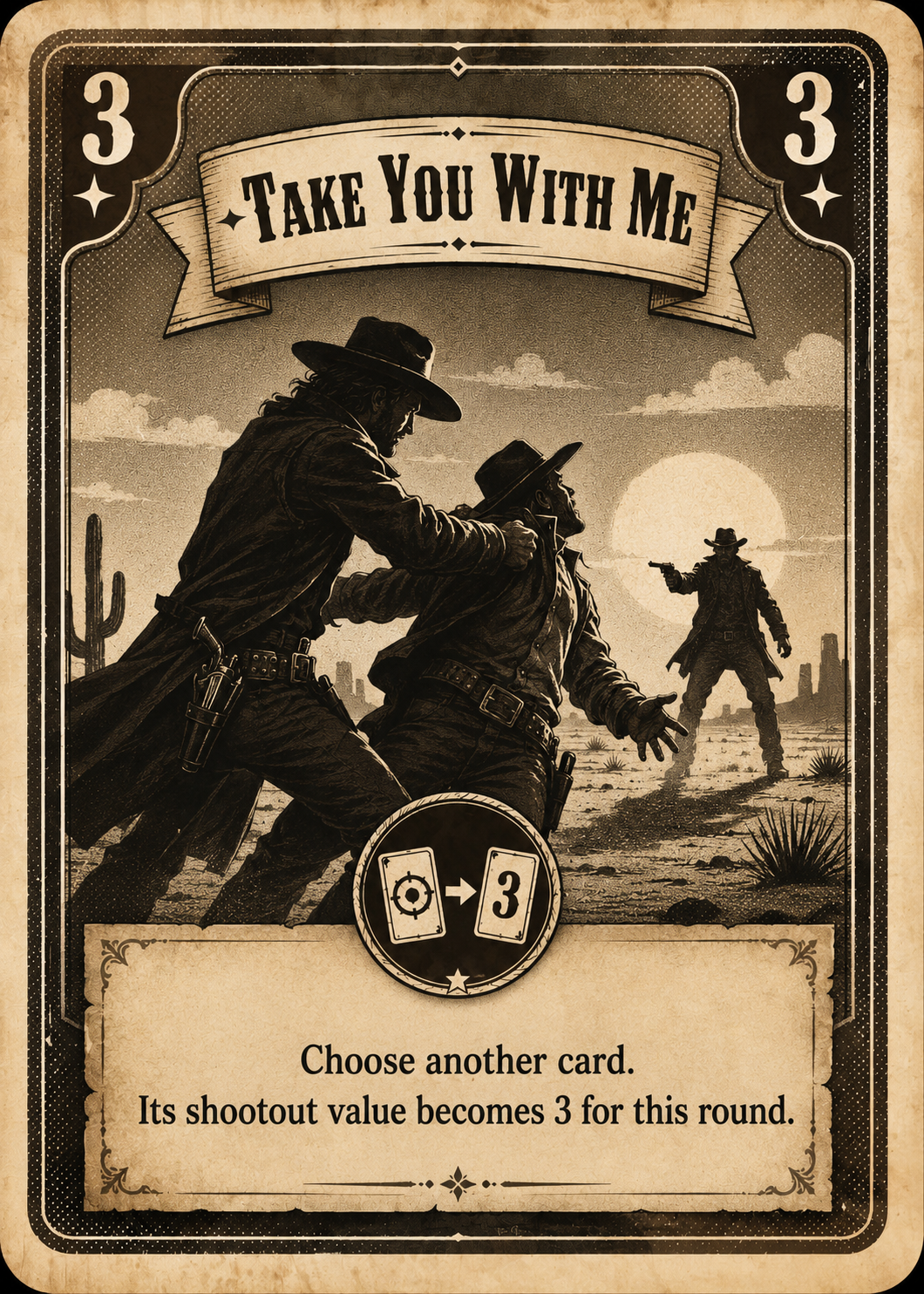
Priority 3
Take You With Me
Targeted value change
If it activates uniquely, choose one other physical card. That card's shootout value becomes 3 for the rest of the round.
- It cannot target itself.
- It cannot target a Steady Hand card that successfully locked.
- Changing shootout value never changes printed priority, card identity, timing, or ownership.
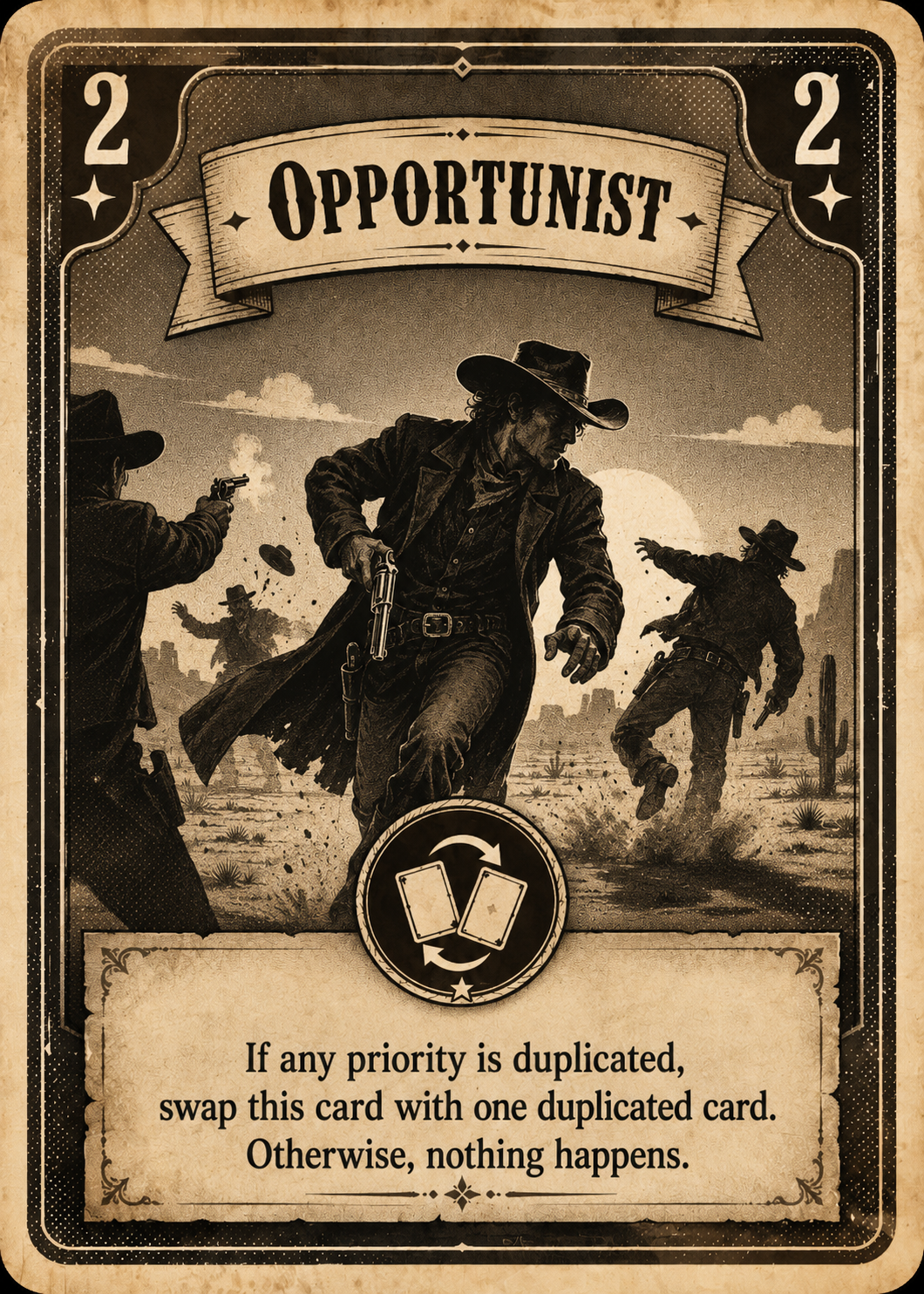
Priority 2
Opportunist
Exploits duplicated priorities
If it activates uniquely, and any printed priority is duplicated in play, choose one card from a duplicated priority and swap physical cards with it.
- The swap is mandatory when at least one legal duplicated-card target exists.
- Duplicated 1s and duplicated 0s count as duplicated priorities.
- Receiving an already-resolved card does not make it activate again.
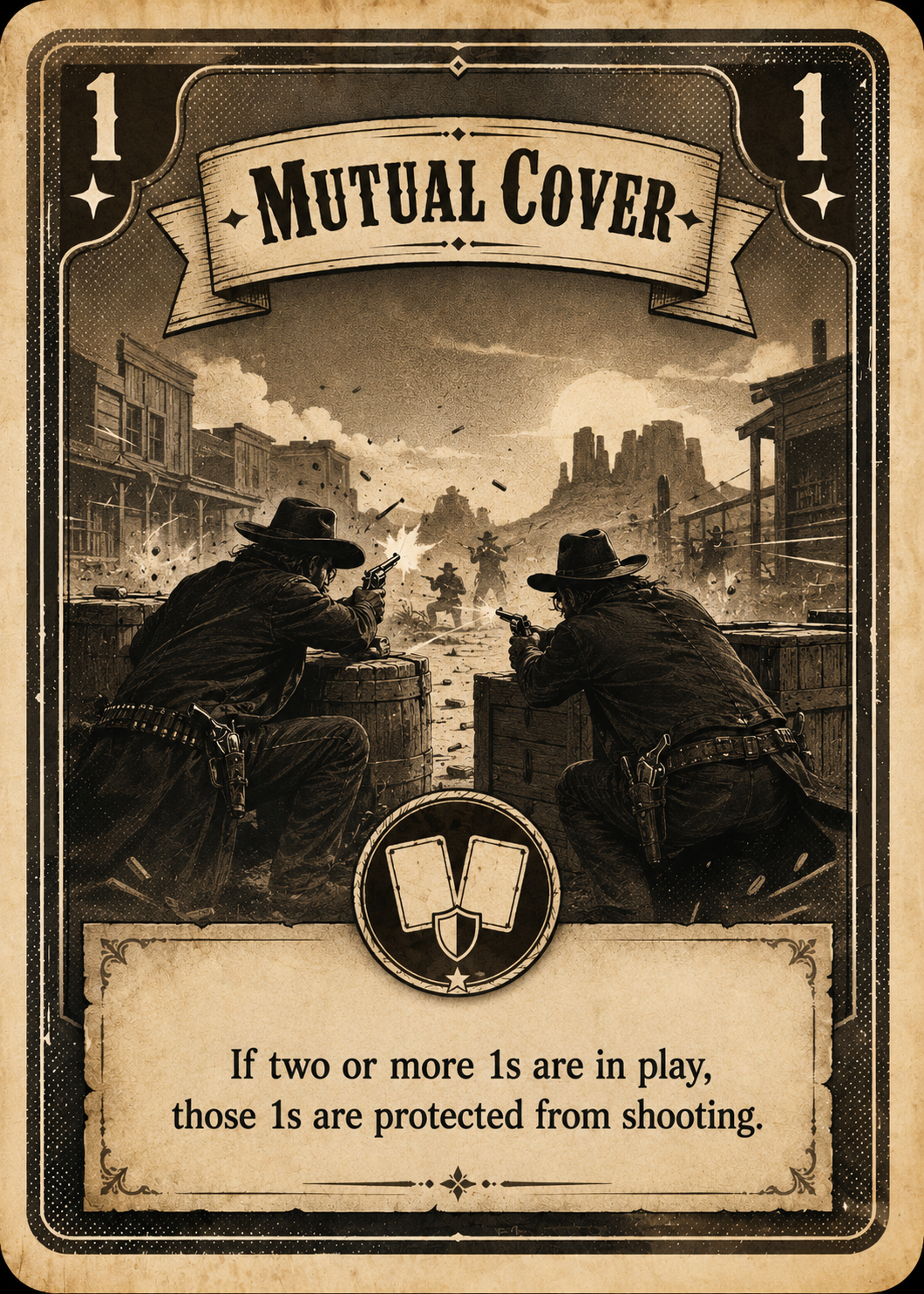
Priority 1
Mutual Cover
Shared protection
When priority 1 resolves, if two or more physical 1s are in play, every physical 1 becomes protected from shooting.
- A single 1 does nothing.
- Physical 1s never cancel each other.
- Protection follows the physical card and is applied before the lowest value is chosen.
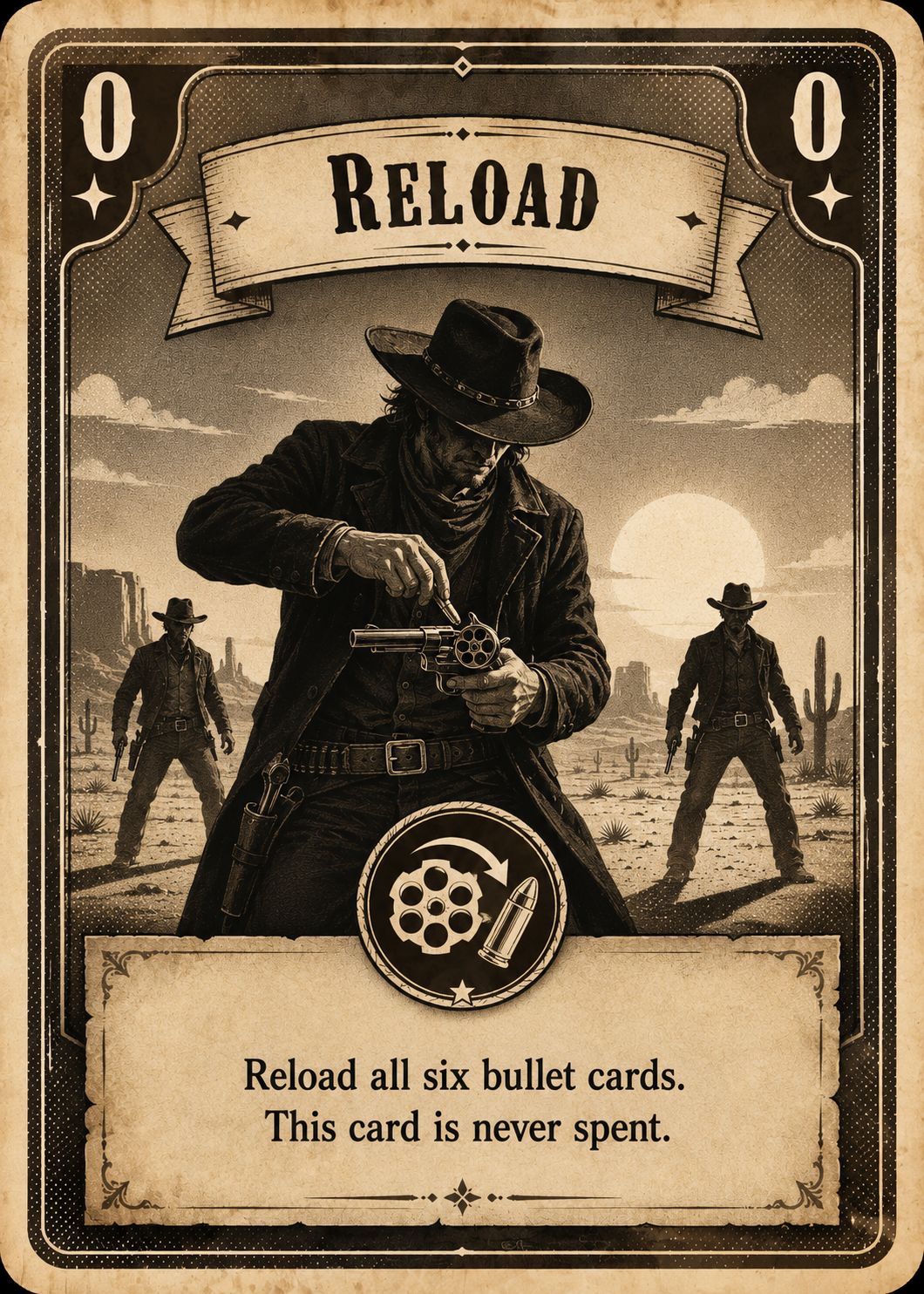
Priority 0
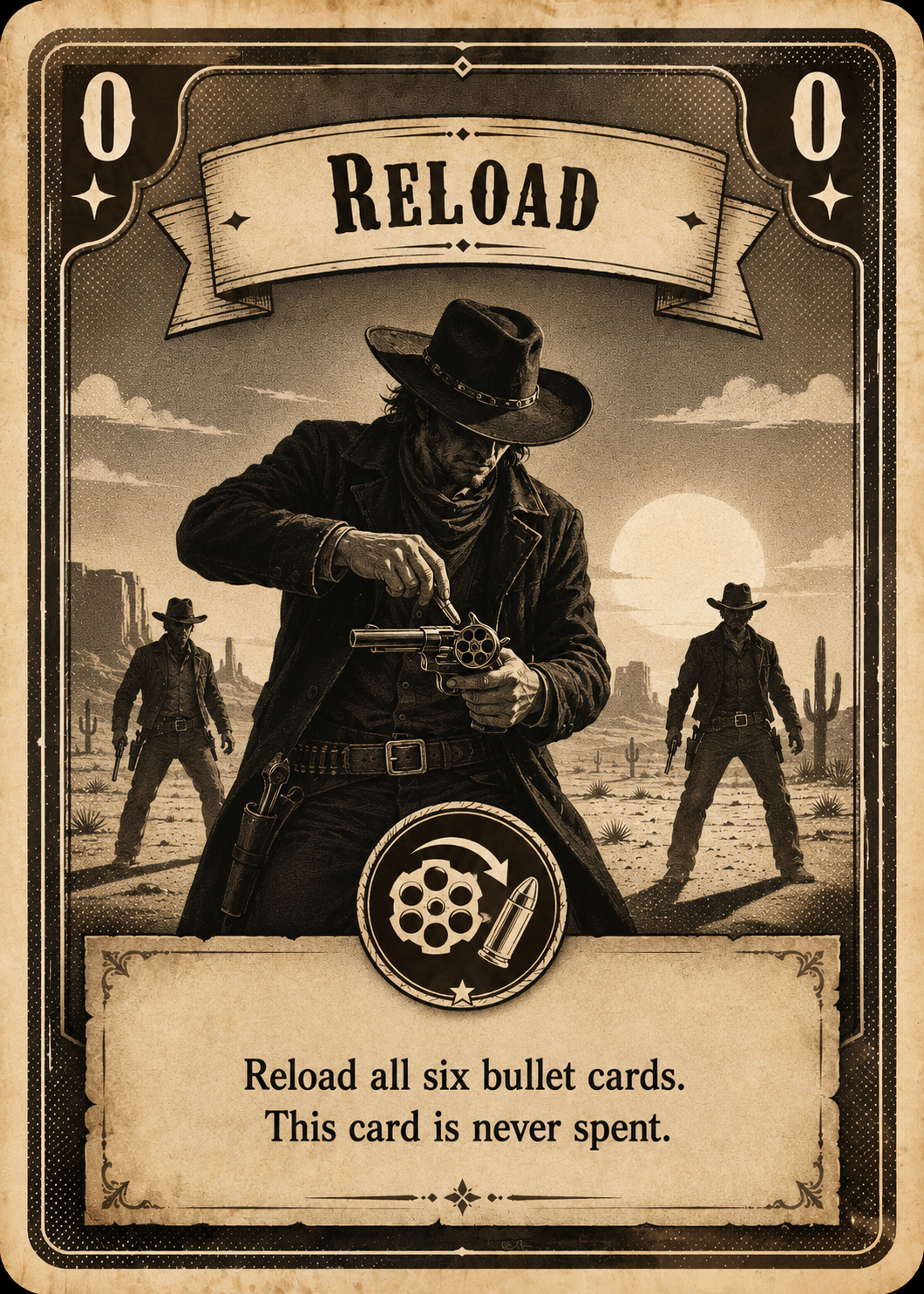
Reload
Dangerous ammunition reset
Every Reload always activates. Its current controller restores all six of their own bullets.
- Reload is never spent and always returns to its original owner.
- Reload gives no shooting protection.
- An unmodified 0 is usually the lowest shootout value and is often shot.
Card set
Set 2: Punishment and recovery
Set 2 keeps the normal deck structure but changes every bullet effect. It adds High Noon, discard pressure, and survival healing.
- Duplicates
- Printed priorities 1 through 5 cancel when duplicated, counting only cards that are still pending at that priority. Reload never cancels. Duplicate 6s do not cancel; they trigger High Noon.
- Ownership
- Ownership and cleanup work like Set 1. Cards return to original owners, spent bullets persist, and Reload restores the reloading player's own bullets.
- Shooting
- Normally use lowest unprotected shooting. If High Noon was triggered by duplicate 6s, the current controllers of those 6s are shot instead, normal lowest-value shooting is skipped, and protection does not save them.
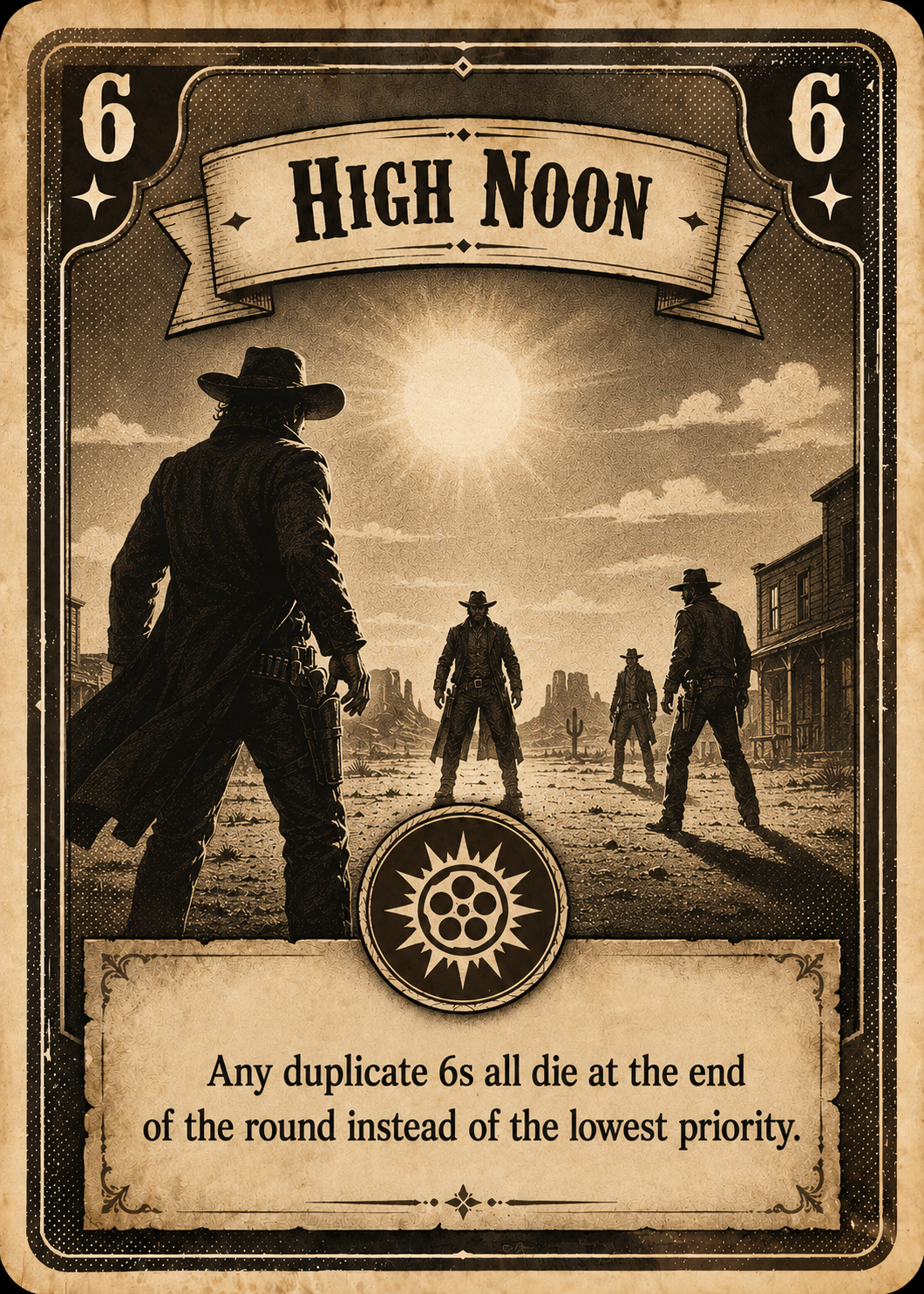
Priority 6
High Noon
Duplicate-6 shootout replacement
If two or more physical 6s are in play, those duplicate-6 controllers are shot during shooting and normal lowest-value shooting is skipped.
- Protection does not save High Noon targets.
- A unique 6 resolves with no effect.
- Duplicate 6s are the exception to Set 2 duplicate cancellation.
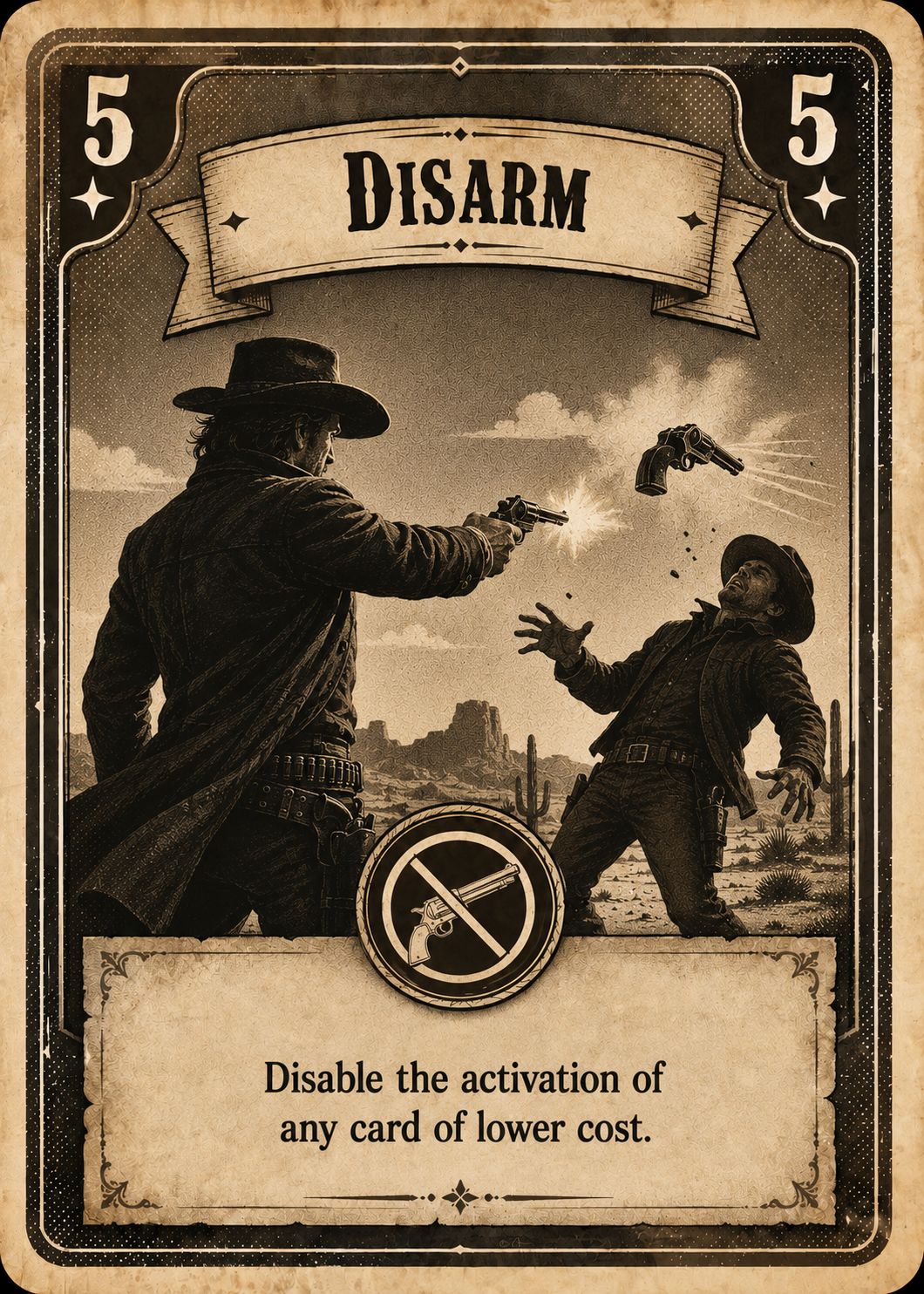
Priority 5
Disarm
Cancel a pending lower card
If it activates uniquely, choose one lower-priority pending non-Reload card. That card is cancelled and will not activate.
- Reload cannot be targeted.
- Already-resolved cards cannot be targeted.
- A card cancelled by Disarm does not count toward later duplicate checks.
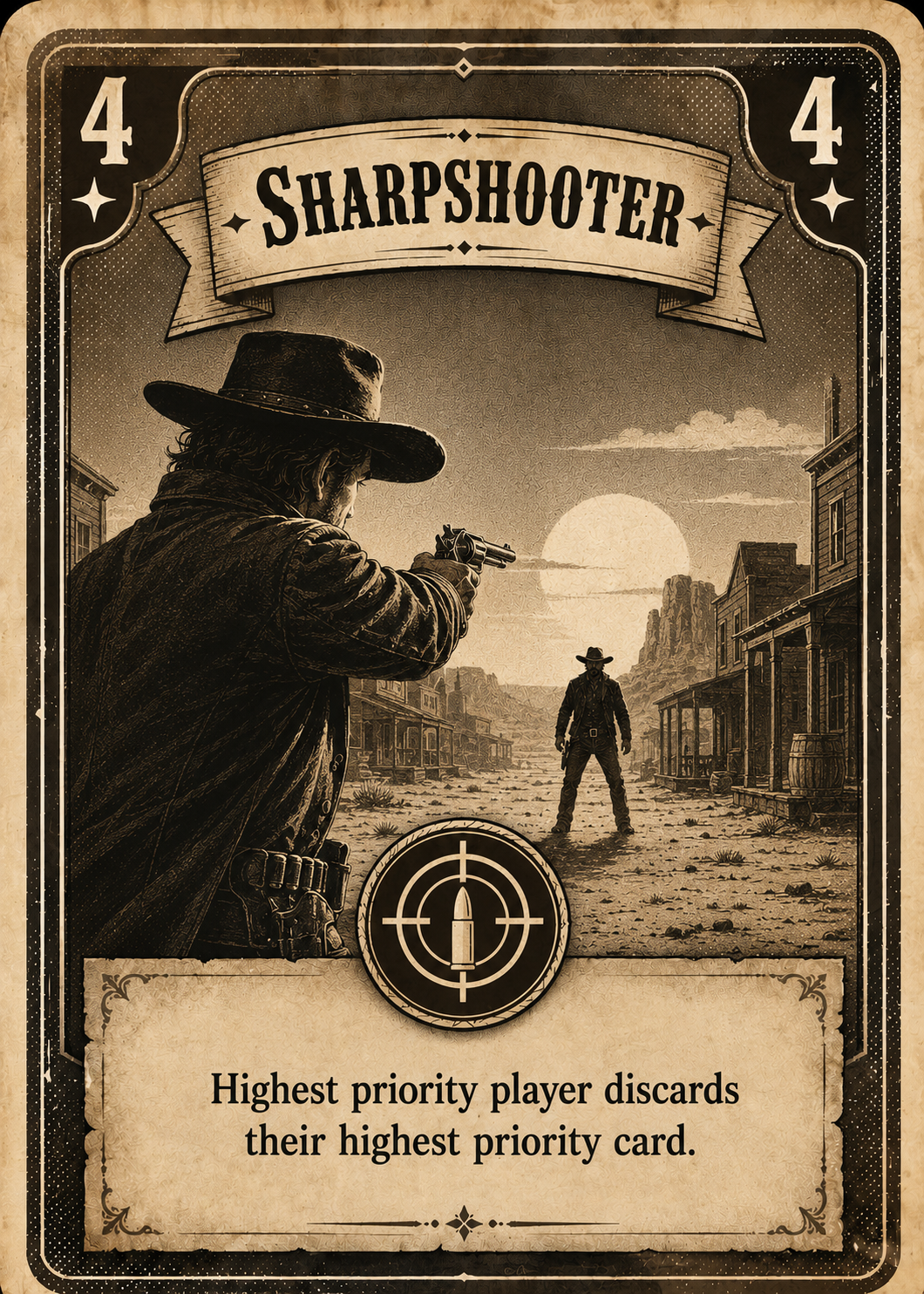
Priority 4
Sharpshooter
Punish the highest active card
If it activates uniquely, the controller or controllers of the highest printed-priority active card discard their highest available bullet from hand.
- Cards already in play are excluded from that discard.
- If a target player has no eligible bullet, nothing happens to that player.
- This is automatic.
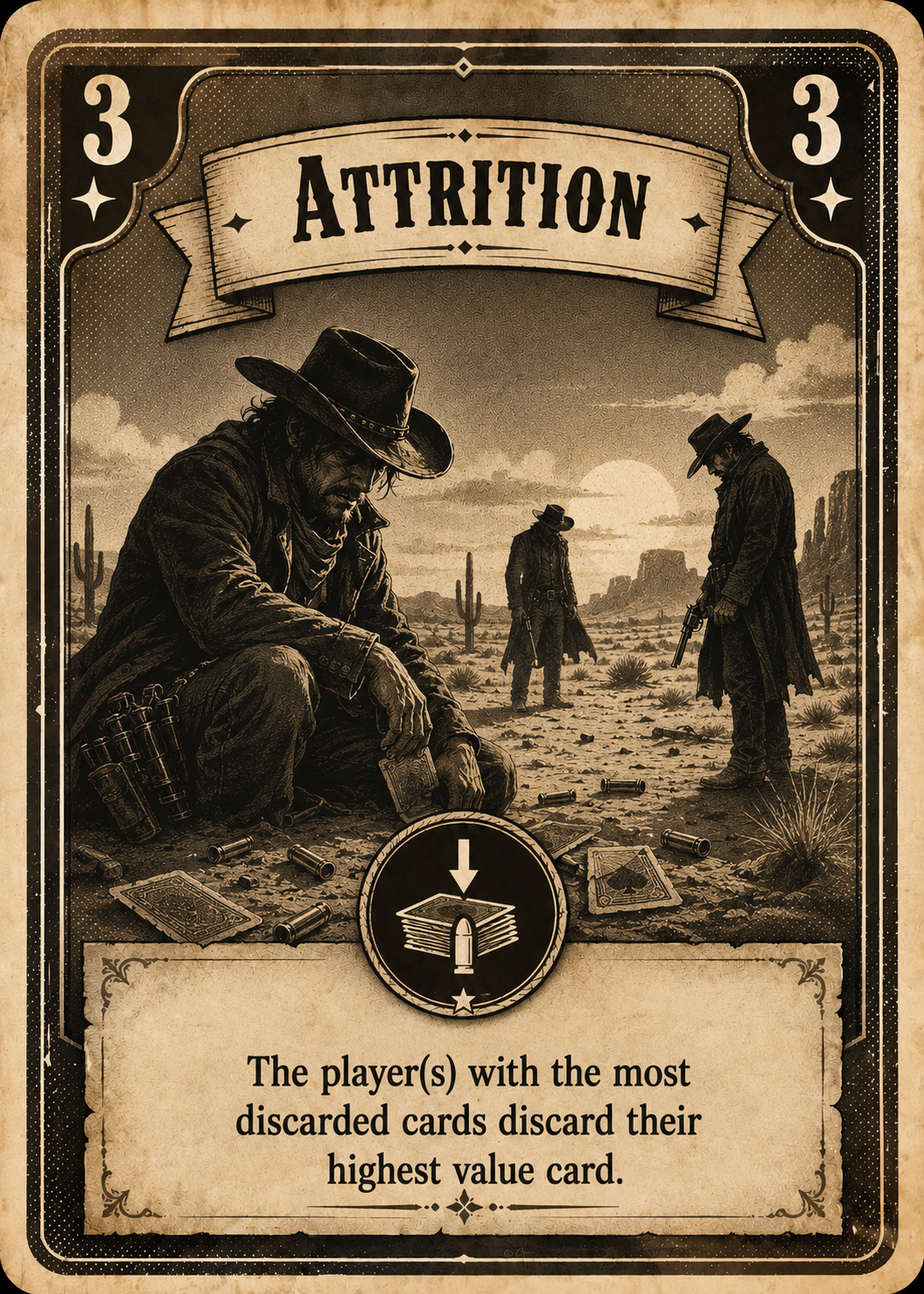
Priority 3
Attrition
Pressure players with spent ammo
If it activates uniquely, every alive player tied for the most spent bullets discards their highest available bullet from hand.
- Cards already in play are excluded from that discard.
- If a target player has no eligible bullet, nothing happens to that player.
- This is automatic.
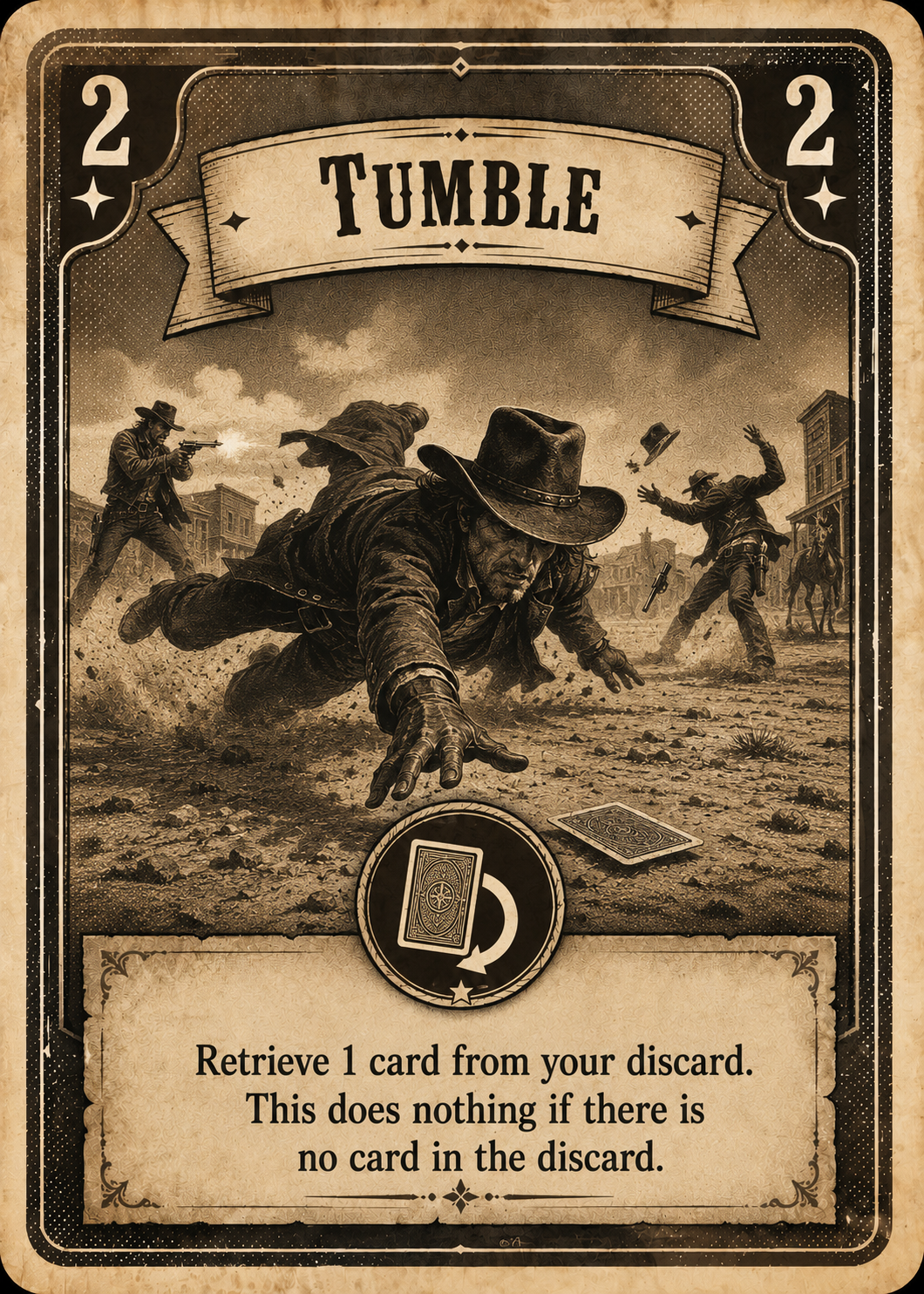
Priority 2
Tumble
Recover one spent bullet
If it activates uniquely and its controller has spent bullets, that controller chooses one spent bullet to retrieve immediately.
- If the controller has no spent bullets, Tumble does nothing.
- The recovered bullet can be used in a later round.
- Duplicate 2s cancel before this decision.
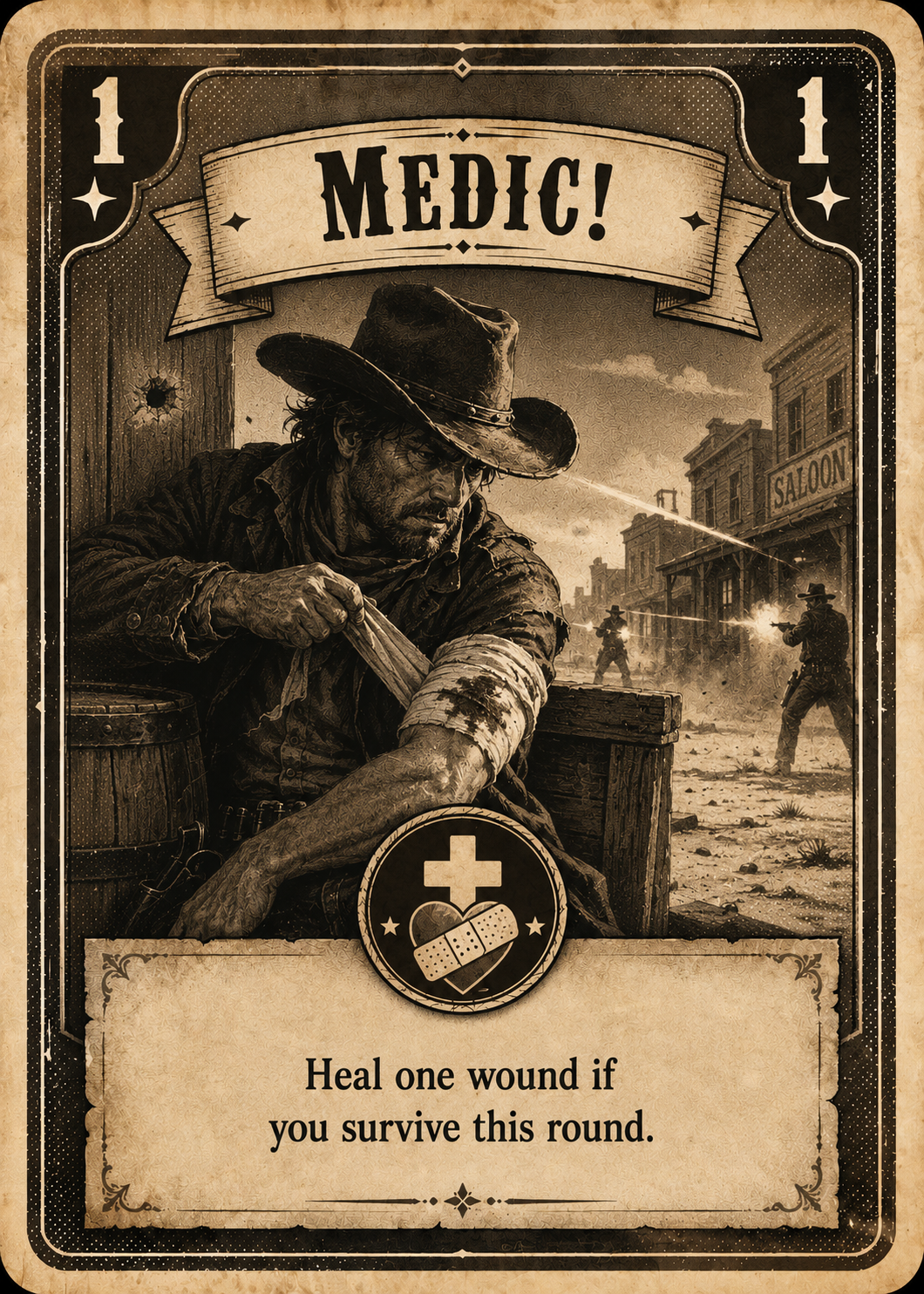
Priority 1
Medic!
Heal if you survive
If it activates uniquely, mark its controller to heal one life if they survive the current standoff.
- Healing is capped at the match starting lives.
- Healing does not happen in a zero-survivor draw.
- Duplicate 1s cancel in Set 2.
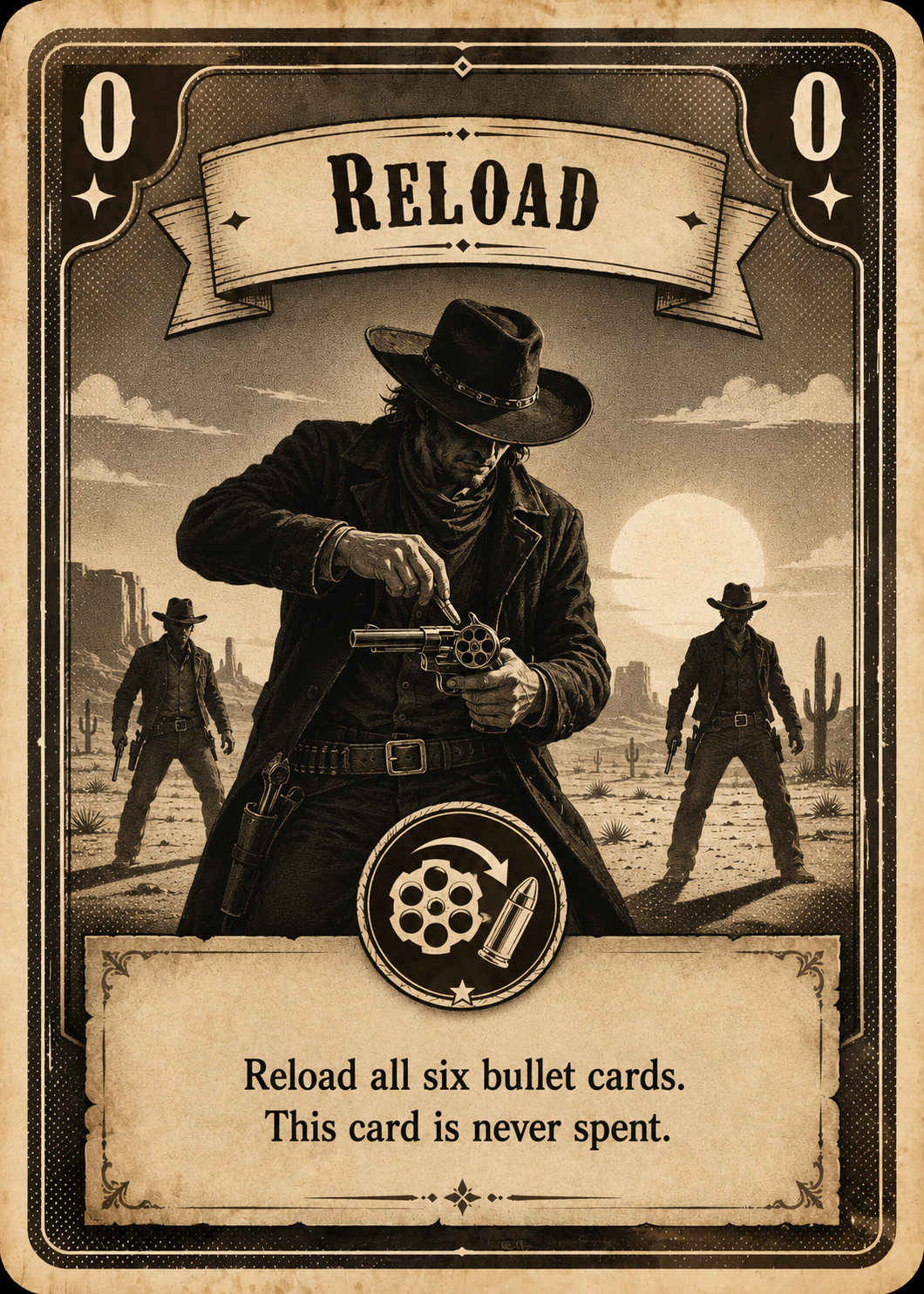
Priority 0
Reload
Standard Reload
Every Reload always activates and restores the current controller's own bullets.
- Reload never cancels on duplicates.
- Reload never becomes spent.
- Reload does not protect you from being shot.
Card set
Set 3: Permanent exchange
Set 3 changes the long game. Several effects permanently exchange physical card ownership, so your future hand can evolve during play.
- Duplicates
- Printed priorities 6, 5, 4, 3, and 2 cancel when duplicated. Physical 1s and 0s use their own exception rules, like Set 1.
- Ownership
- Set 3 exchanges are permanent. Current ownership changes, active cards swap positions when relevant, and each player still owns seven cards after every one-for-one exchange.
- Shooting
- Set 3 uses normal lowest unprotected shooting. Its main difference is that cleanup and Reload use current ownership instead of original ownership.
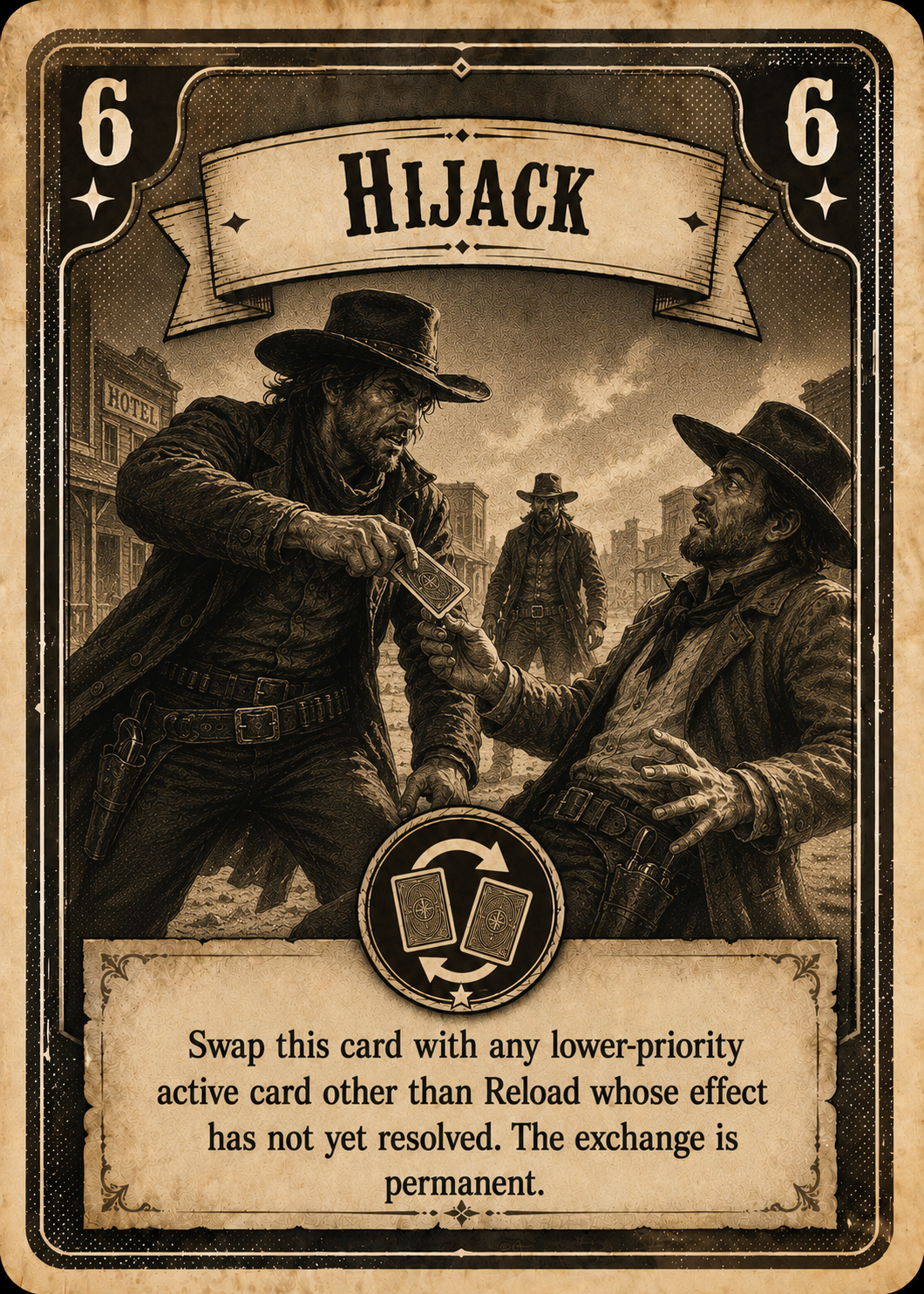
Priority 6
Hijack
Permanent high-speed steal
If it activates uniquely, choose an unresolved active physical card with printed priority 1 through 5. Permanently exchange ownership and active positions with it.
- Reload cannot be targeted.
- Already-resolved cards cannot be targeted.
- The received lower-priority unresolved card may activate later for its new controller.
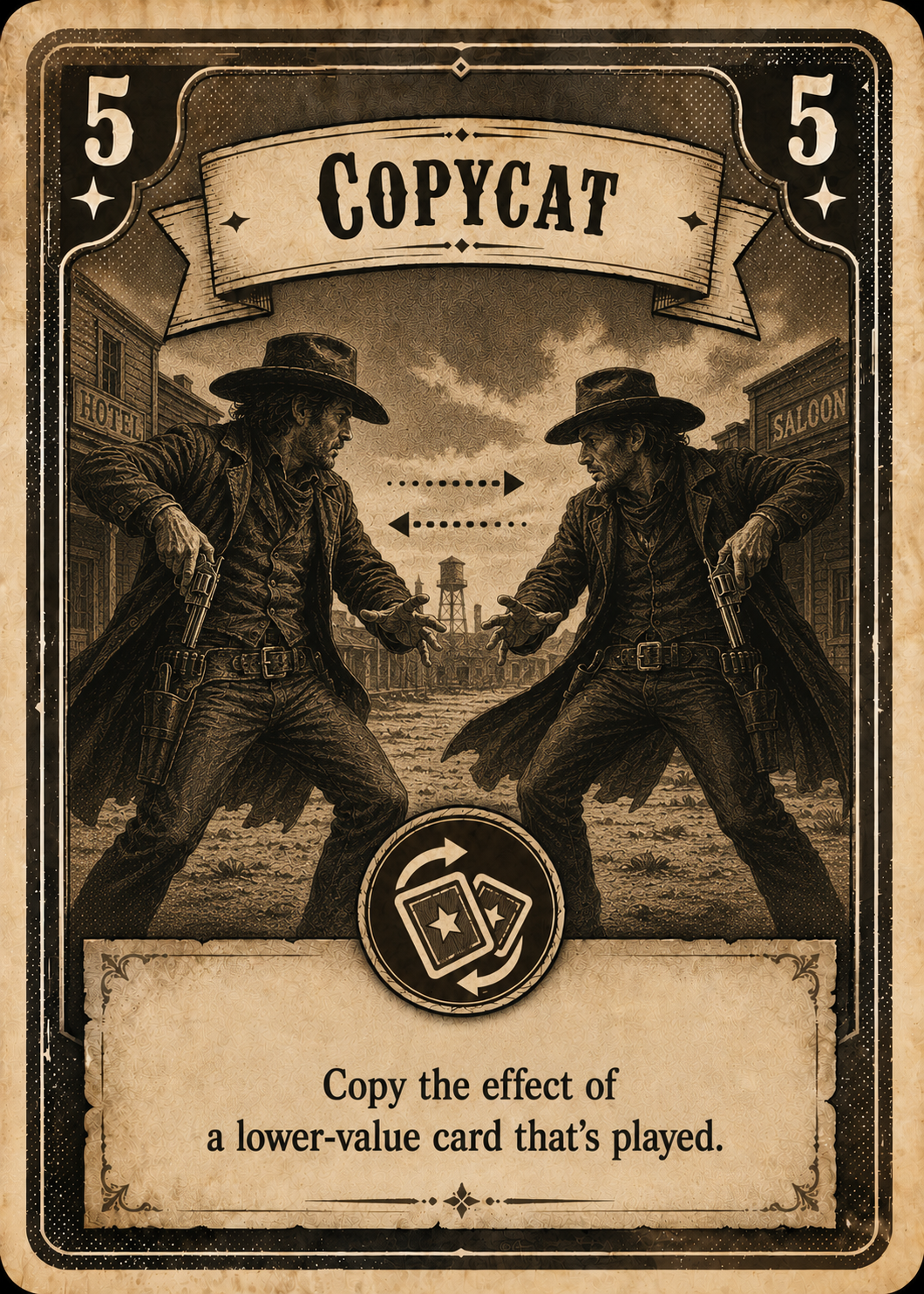
Priority 5
Copycat
Immediate copied effect
If it activates uniquely, choose an active physical card with printed priority 0 through 4 and copy that card's effect immediately.
- Copycat remains a physical 5 and keeps shootout value 5 unless another effect changes it.
- Copycat cannot copy another 5 or a 6.
- Copying Reload immediately returns the Copycat controller's current discard pile to hand.
Priority 4
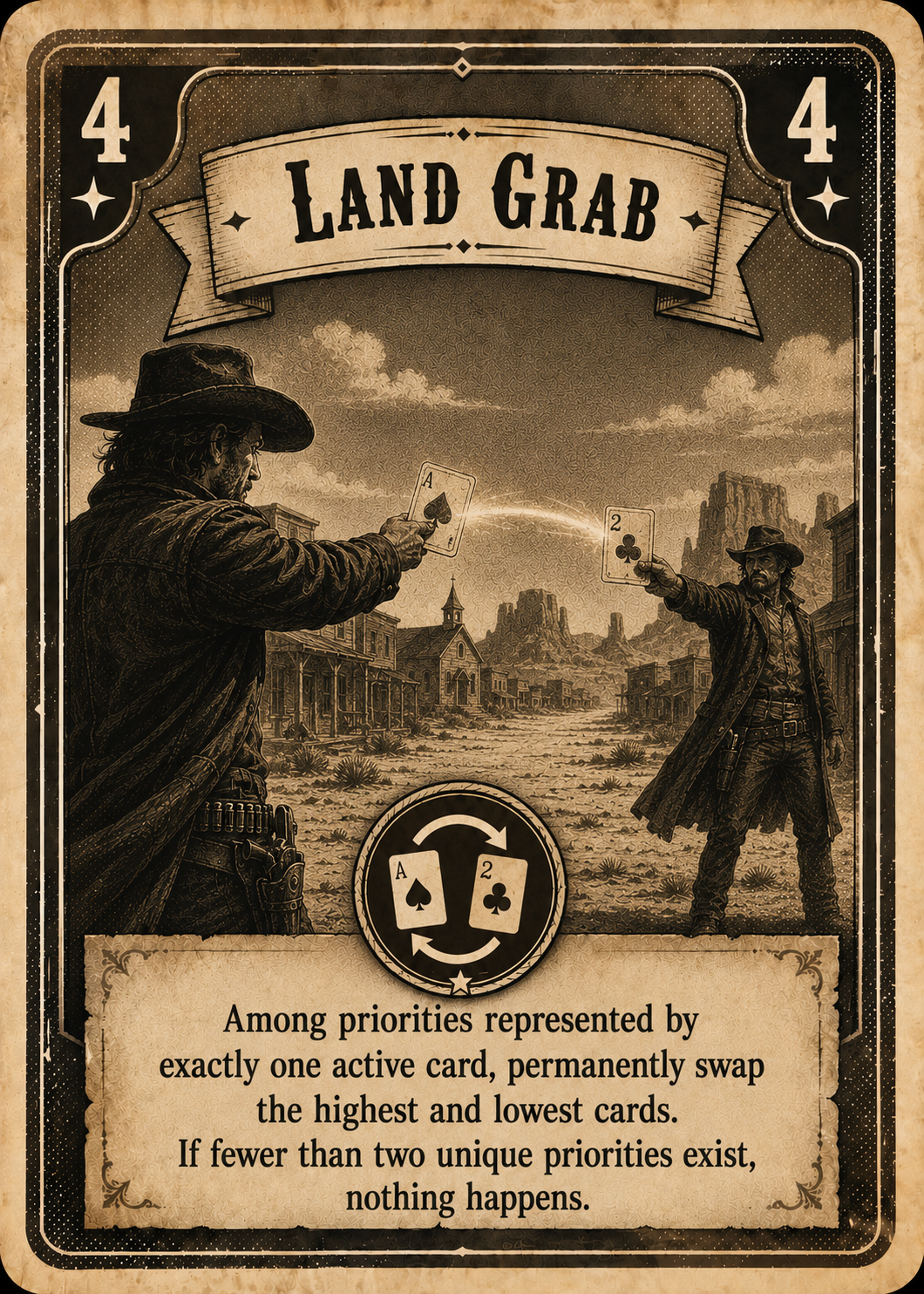
Land Grab
Automatic permanent exchange
If it activates uniquely, ignore duplicated active printed priorities, then permanently exchange the highest and lowest remaining unique physical cards.
- The exchanged cards also swap active positions and controllers.
- Activation state is preserved.
- If fewer than two unique active priorities remain, nothing happens.
Priority 3
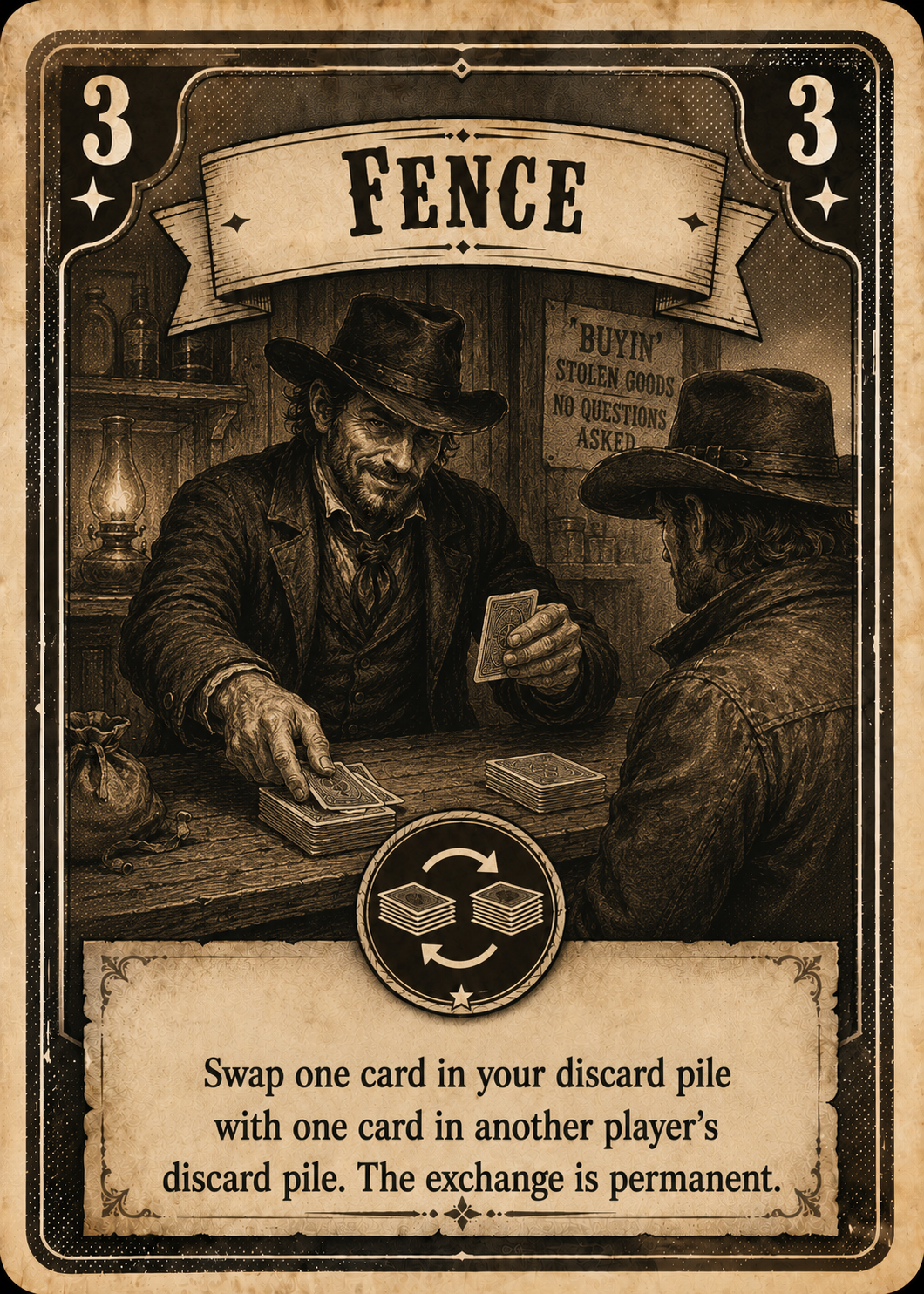
Fence
Trade from discard piles
If it activates uniquely, choose one non-Reload card in your discard pile and one non-Reload card in another living player's discard pile. Permanently exchange ownership of those discarded cards.
- Both cards remain discarded after the exchange.
- If either side has no legal discarded card, Fence does nothing.
- The future Reload owner is the new current owner.
Priority 2
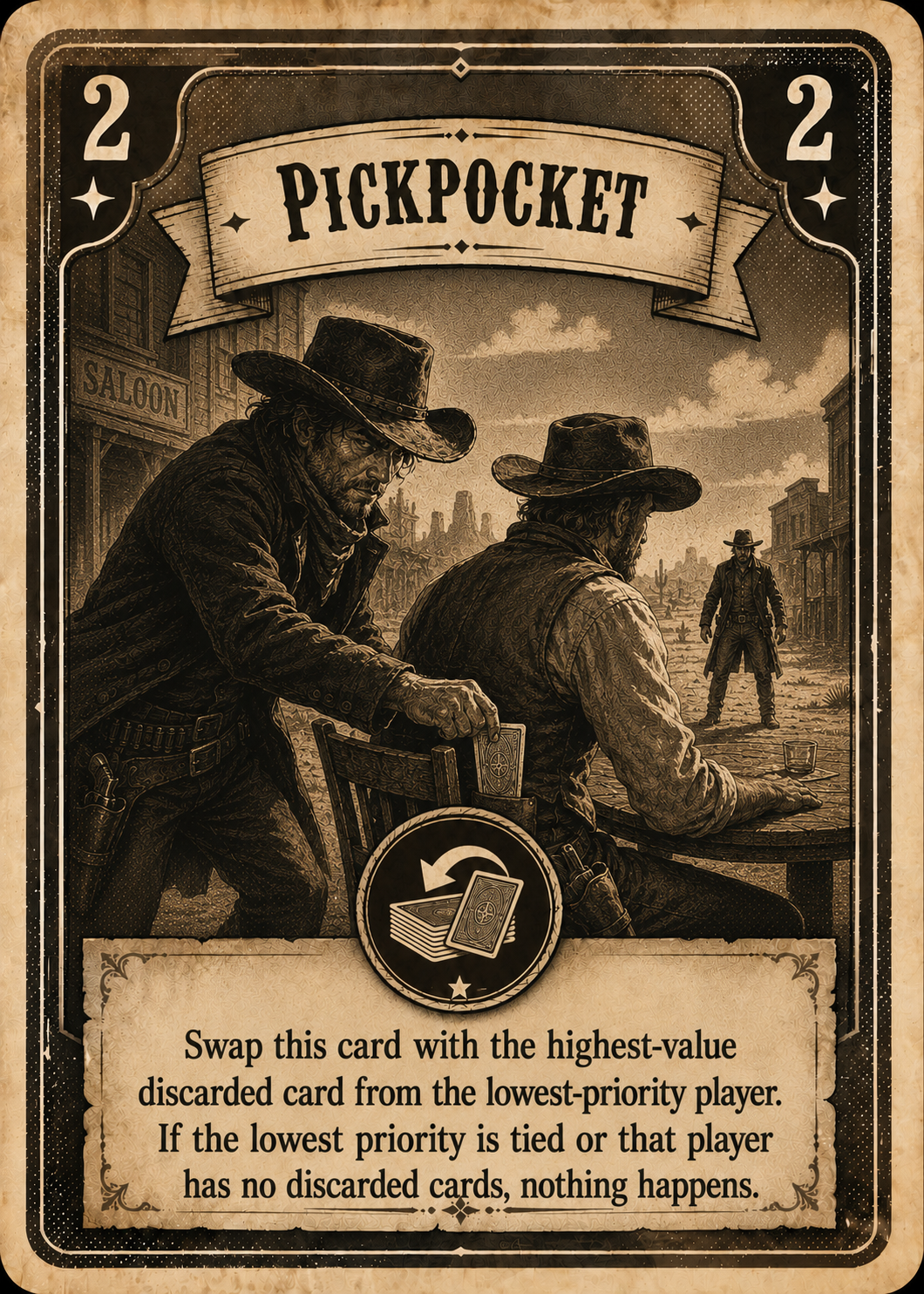
Pickpocket
Steal from the lowest active player
If it activates uniquely, find the controller of the unique lowest printed-priority active card. Take that player's highest discarded bullet into Pickpocket's active position, and move Pickpocket to that player's discard pile.
- If the lowest active printed priority is tied, nothing happens.
- If that player has no discarded bullet, nothing happens.
- The two physical cards permanently exchange ownership.
Priority 1
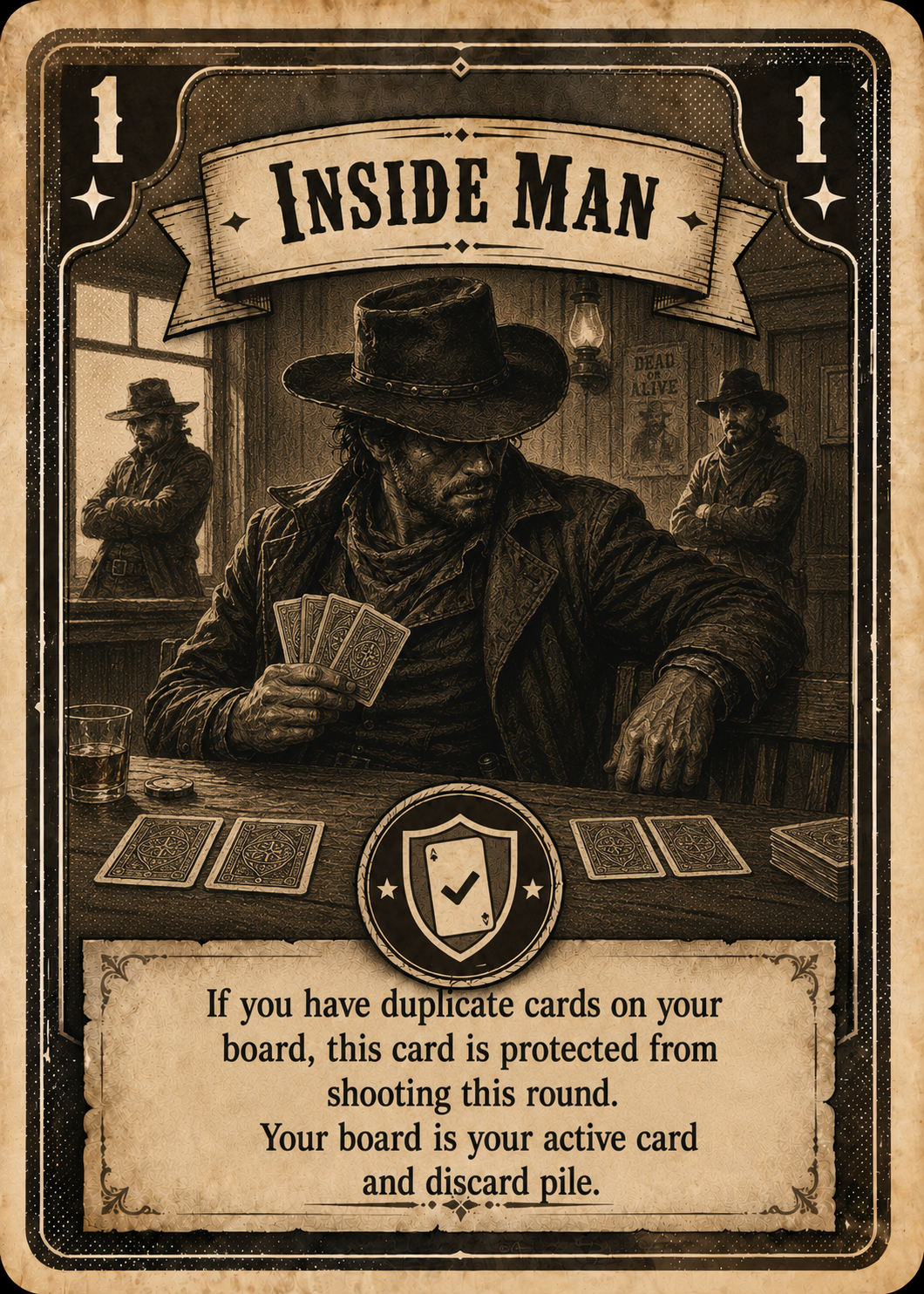
Inside Man
Visible-card protection check
When a physical 1 activates, check its controller's active card and discard pile. If any printed priority appears at least twice among those visible cards, protect this Inside Man card.
- Cards in hand do not count.
- Each physical 1 checks independently.
- Protection applies only to that active physical 1.
Priority 0
Reload
Reload current ownership
Reload returns every card currently owned by the reloading player from that player's discard pile to hand.
- Cards you permanently gained come back to you.
- Cards you permanently lost do not come back to you.
- Reload itself is never discarded.
Card set
Set 4: Current value
Set 4 keeps printed priority as identity and timing, but effects change temporary current values used for the final shootout.
- Duplicates
- Printed priorities 6 through 1 cancel when duplicated, regardless of current value changes. Reload never cancels. Equal current values alone never create duplicate cancellation.
- Ownership
- Ownership, ammunition, swaps, and Reload cleanup use the Set 1 and Set 2 original-owner model. Current values reset at cleanup.
- Shooting
- Normally shoot the lowest unprotected current value. If Bounty is armed and at least one eligible value is above 6, shoot every eligible card tied at the highest value above 6 instead.
Priority 6
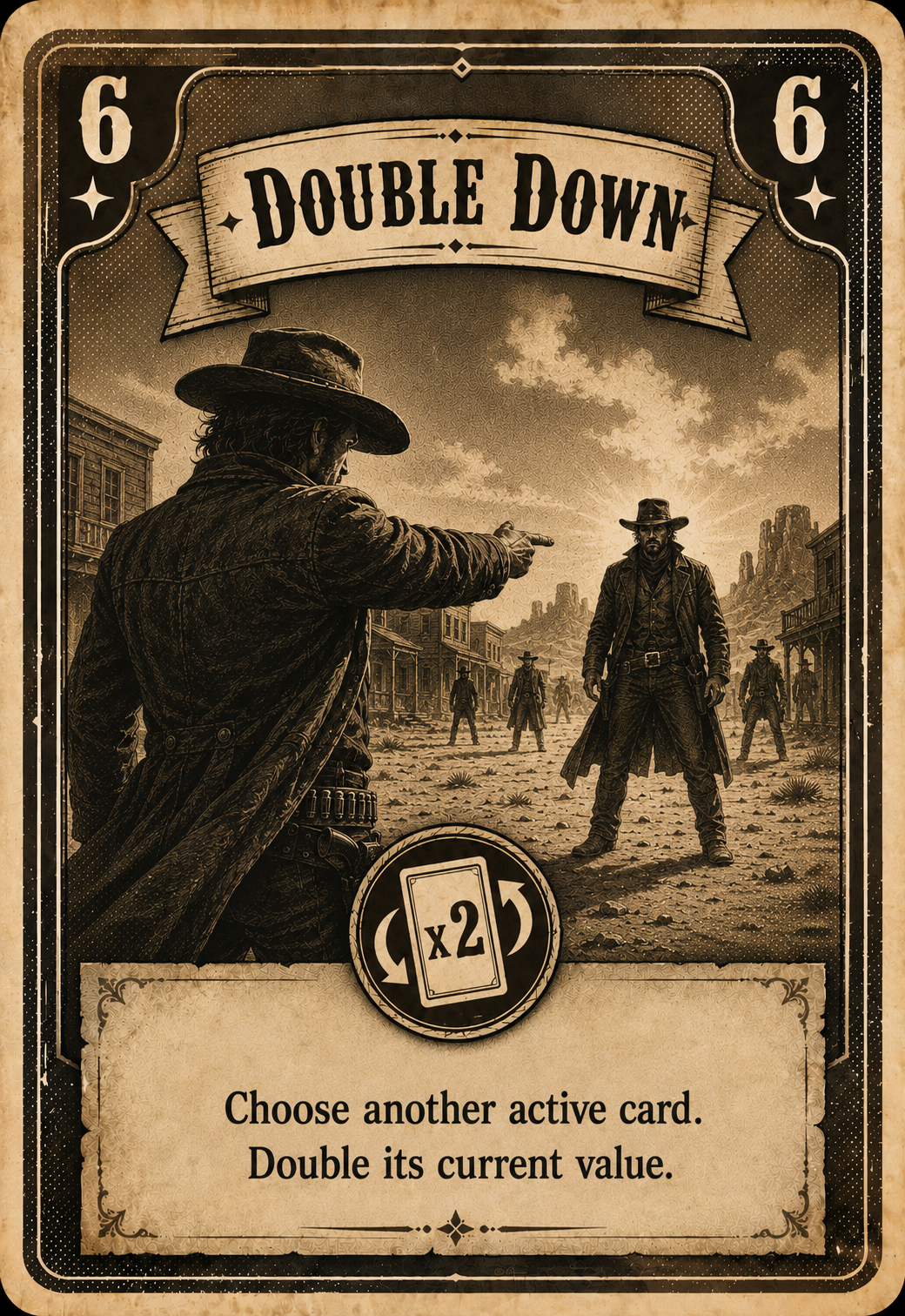
Double Down
Raise a current value
If it activates uniquely, choose another active card and double that card's current value.
- It cannot target itself.
- Values can go above 6.
- Doubling 0 leaves it at 0.
Priority 5
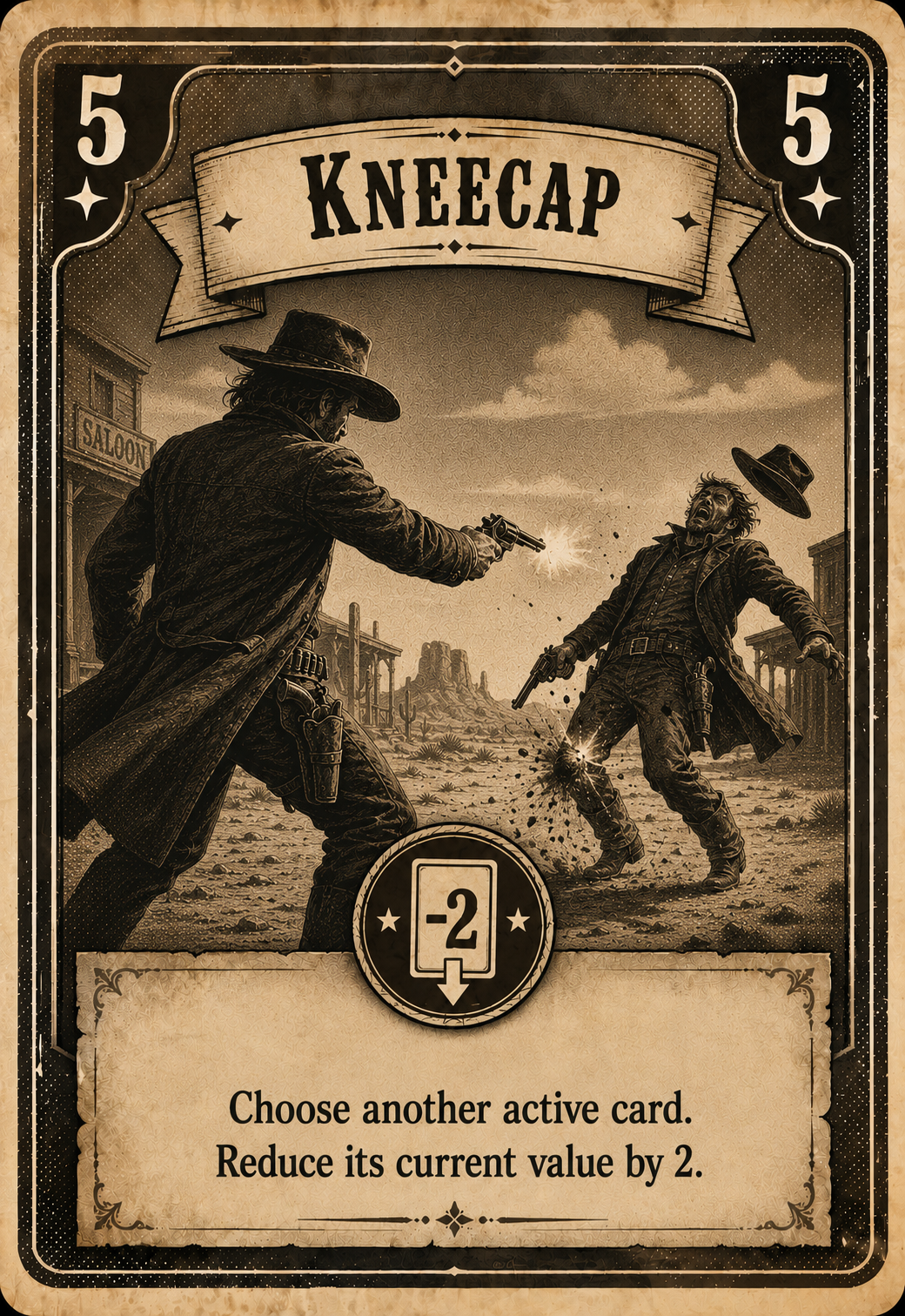
Kneecap
Lower a current value
If it activates uniquely, choose another active card and subtract 2 from that card's current value, to a minimum of 0.
- It cannot target itself.
- It can target any other active card, resolved or unresolved.
- Printed priority never changes.
Priority 4
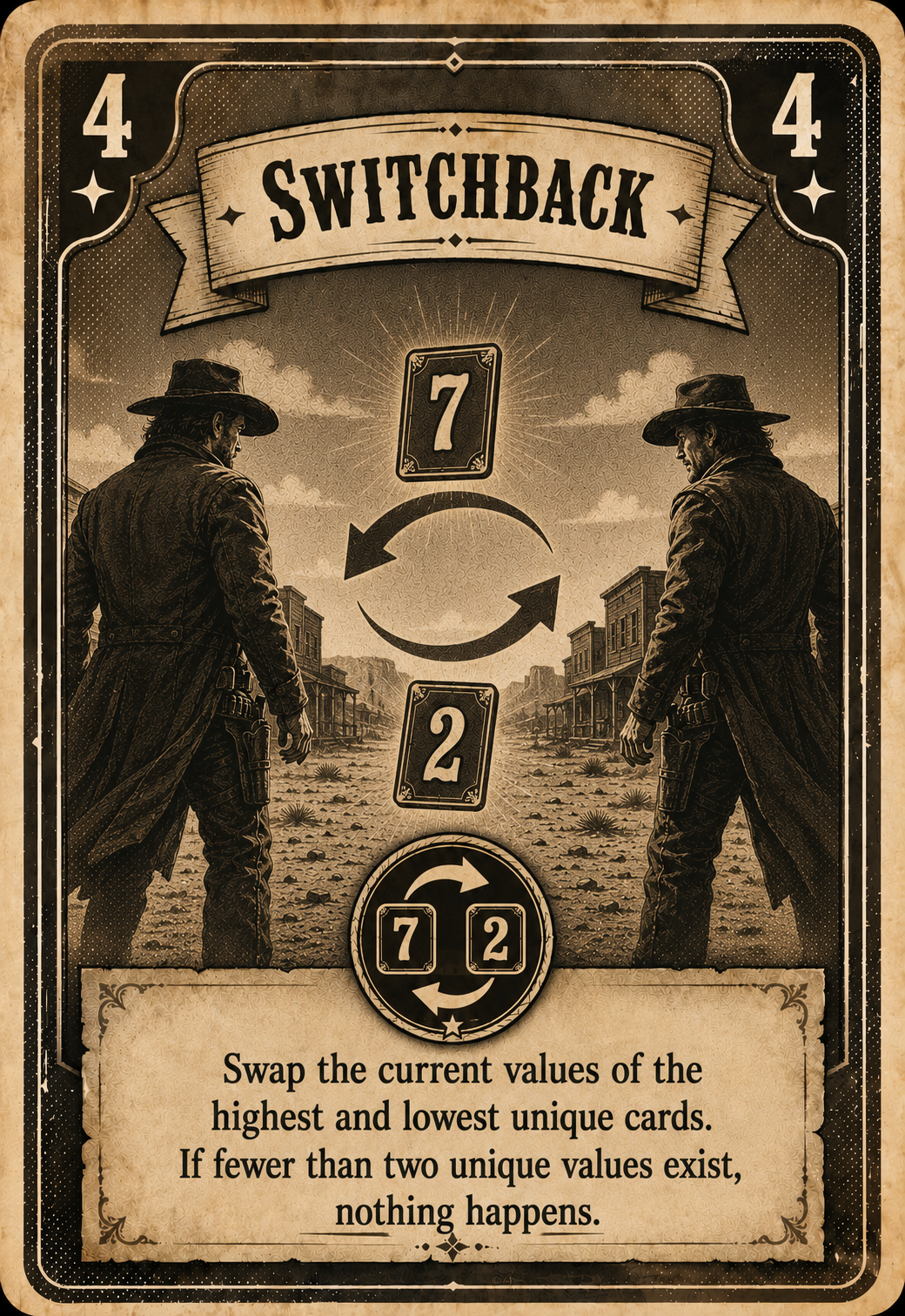
Switchback
Swap extreme unique values
If it activates uniquely, ignore all tied current-value groups, then exchange the current values of the highest and lowest remaining unique cards.
- Physical cards do not move.
- Controllers do not change.
- If fewer than two unique current-value groups remain, Switchback fizzles.
Priority 3
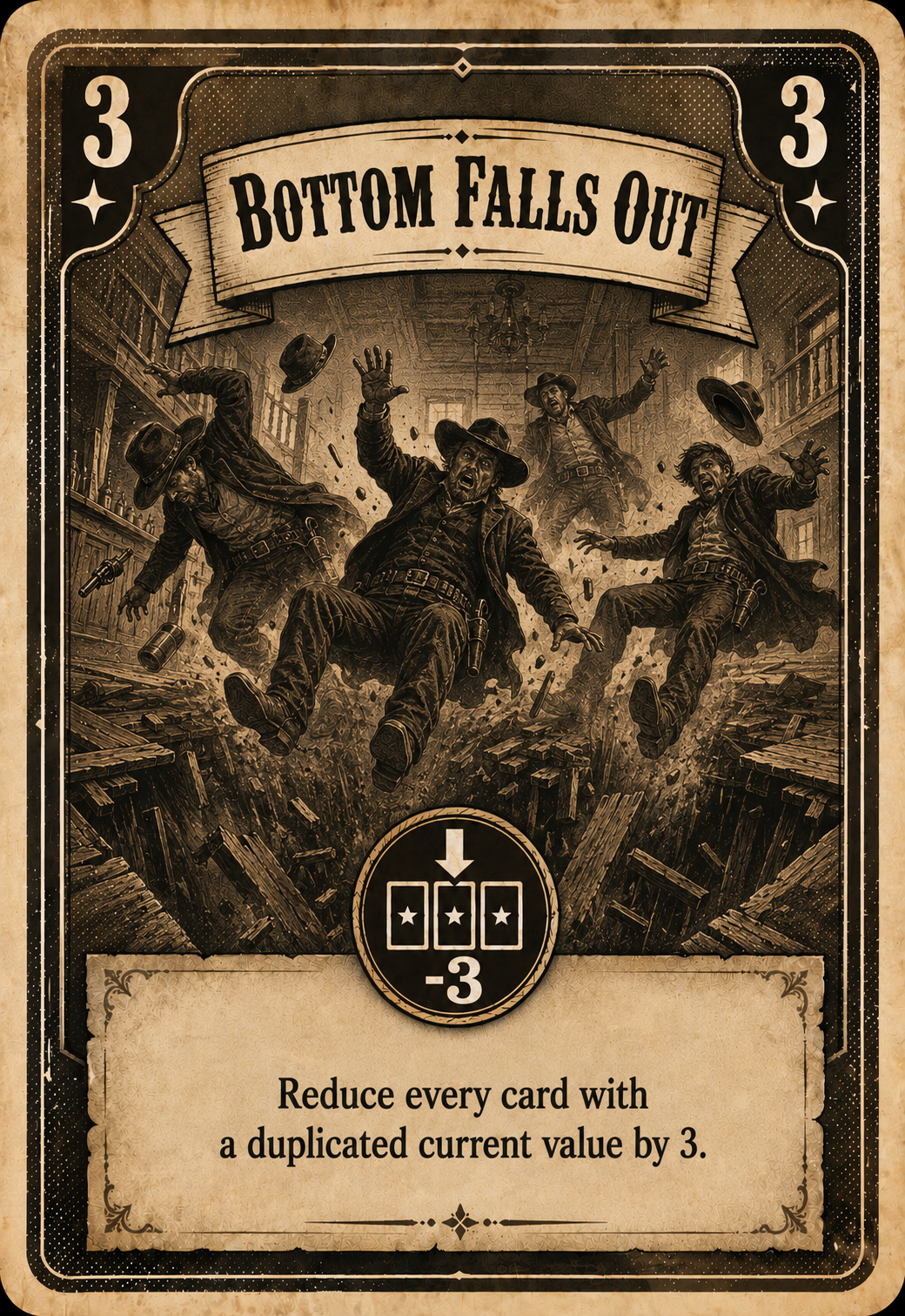
Bottom Falls Out
Punish tied current values
If it activates uniquely, snapshot every current-value group containing at least two cards, then subtract 3 from every card in those snapshotted groups, to a minimum of 0.
- Each snapshotted card is reduced once.
- Cards that become tied because of the reductions are not added.
- Printed priority remains unchanged.
Priority 2
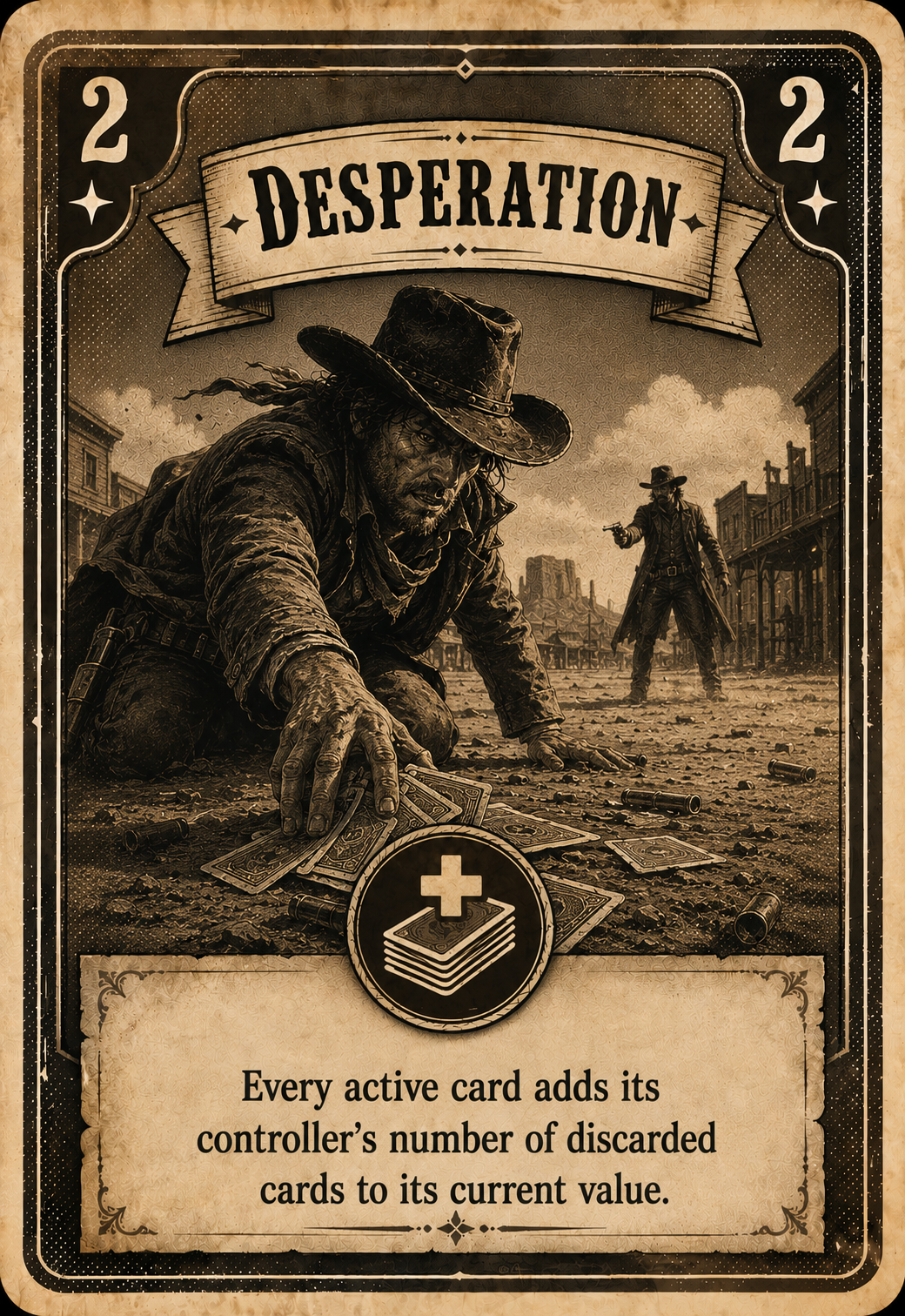
Desperation
Spent-ammo value boost
If it activates uniquely, snapshot each player's spent-bullet count and add that count to the active card currently controlled by that player.
- The bonus can raise values above 6.
- Counts are snapshotted when Desperation resolves.
- The bonus follows current control at that moment.
Priority 1
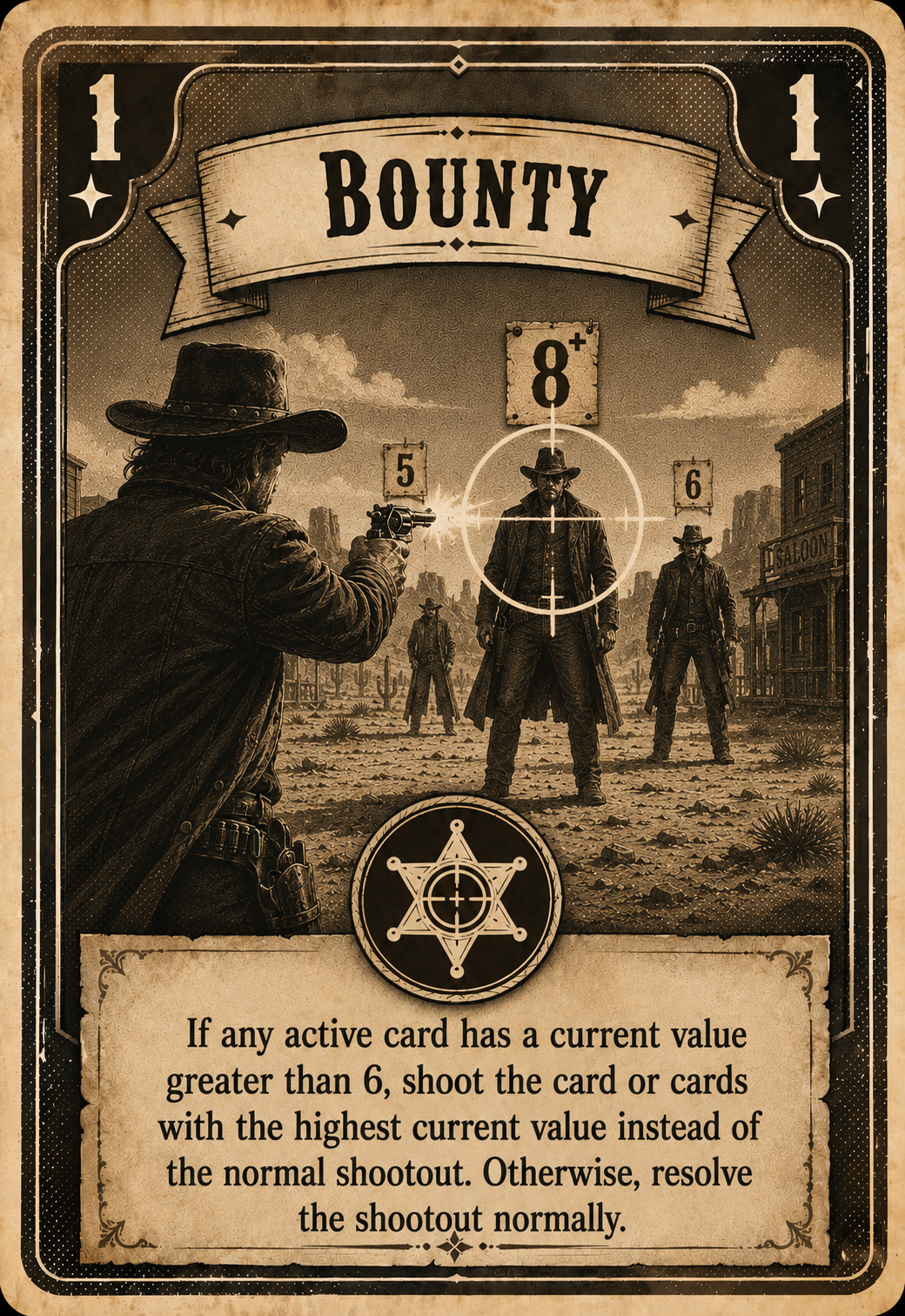
Bounty
High-value shooting replacement
If it activates uniquely, arm Bounty for this round's shooting step.
- Protection is applied before Bounty checks values.
- Bounty only replaces shooting if an eligible current value is above 6.
- If no eligible value exceeds 6, normal lowest-value shooting happens.
Priority 0
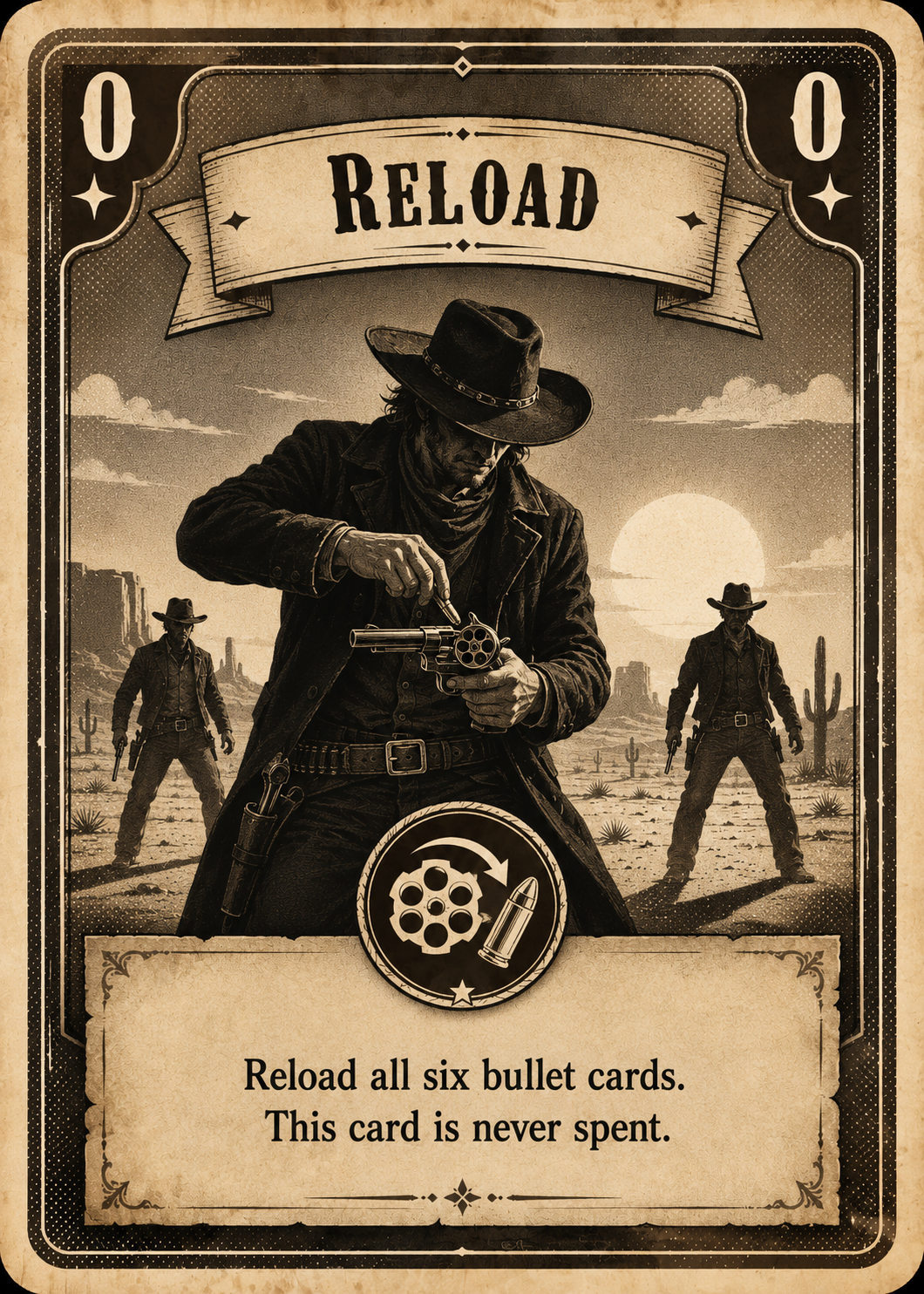
Reload
Standard Reload
Every Reload always activates and restores the current controller's own bullets.
- Reload never cancels.
- Reload never becomes spent.
- Reload gives no shooting protection.
Card set
Set 5: Discard and retrieval
Set 5 uses hand, active, and discard zones during the round. Action cards can discard, retrieve, trigger When Discarded effects, and change current values.
- Duplicates
- At reveal, every duplicated printed Action priority 1 through 6 is disabled. Disabled Action cards skip their own Main Effect, discard sequence, value gain, retrieval, and When Discarded chain, but they stay active and can be affected by other cards. Reload is never disabled by duplicates.
- Ownership
- Original ownership stays fixed like Sets 1, 2, and 4. During a round, Action cards move between hand, active, and discard. Reload is never discarded or retrieved by Set 5 sequences.
- Shooting
- Normally shoot the lowest unprotected current-value tier. Last Stand shoots the bottom two distinct unprotected tiers instead. Marked players are also shot if unprotected. Each player is shot at most once.
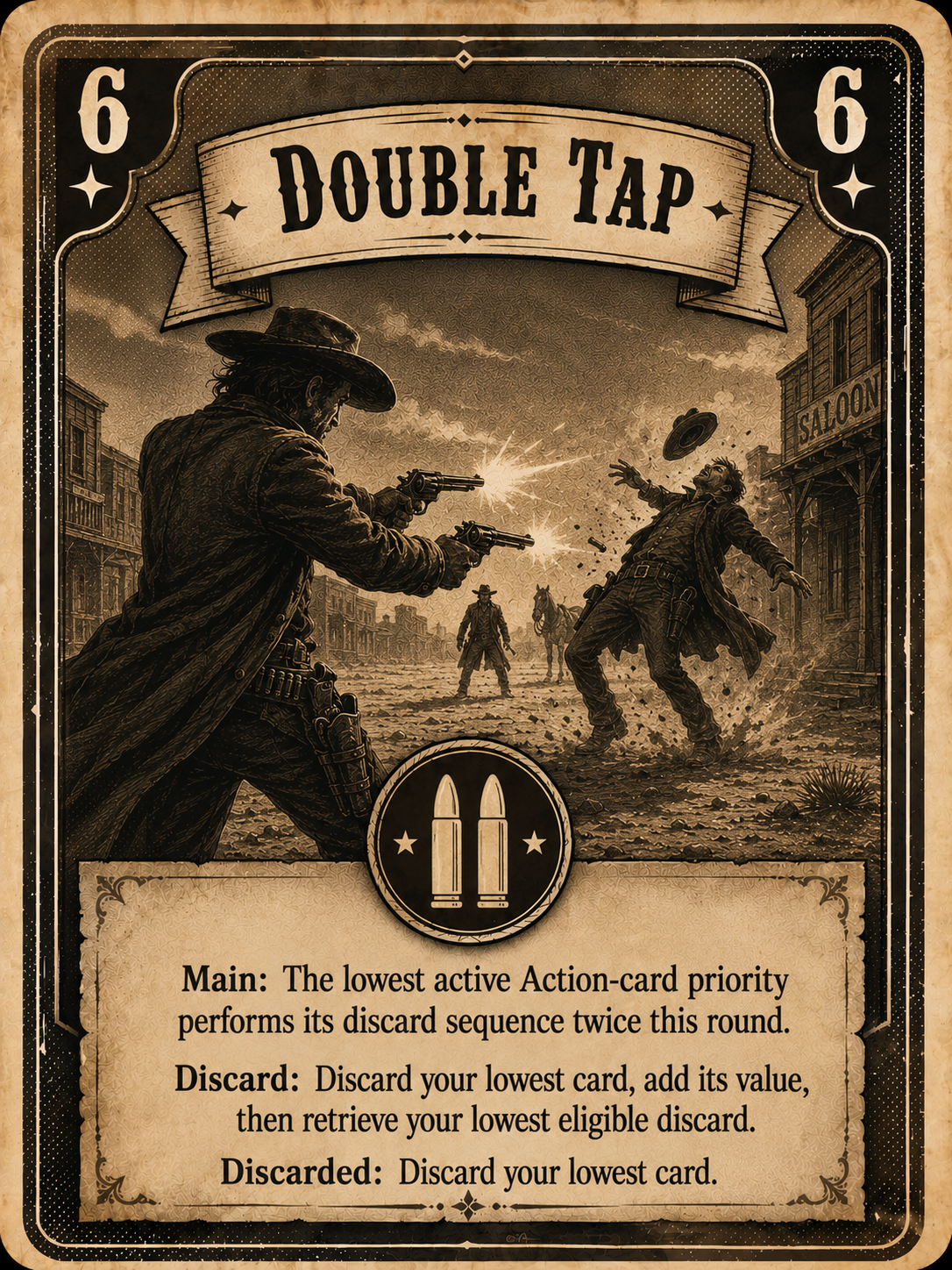
Priority 6
Double Tap
Grant a second discard sequence
Main Effect: find the lowest printed active Action priority and grant each non-disabled card at that priority two total sequences when it finishes.
- Discard sequence: discard lowest Action, add its printed priority to this card's current value, retrieve lowest eligible discarded Action, then resolve When Discarded.
- When Discarded: force-discard your lowest Action with no value gain and no retrieval, then resolve that new discard's When Discarded.
- Suppressing Fire can block the forced discard.
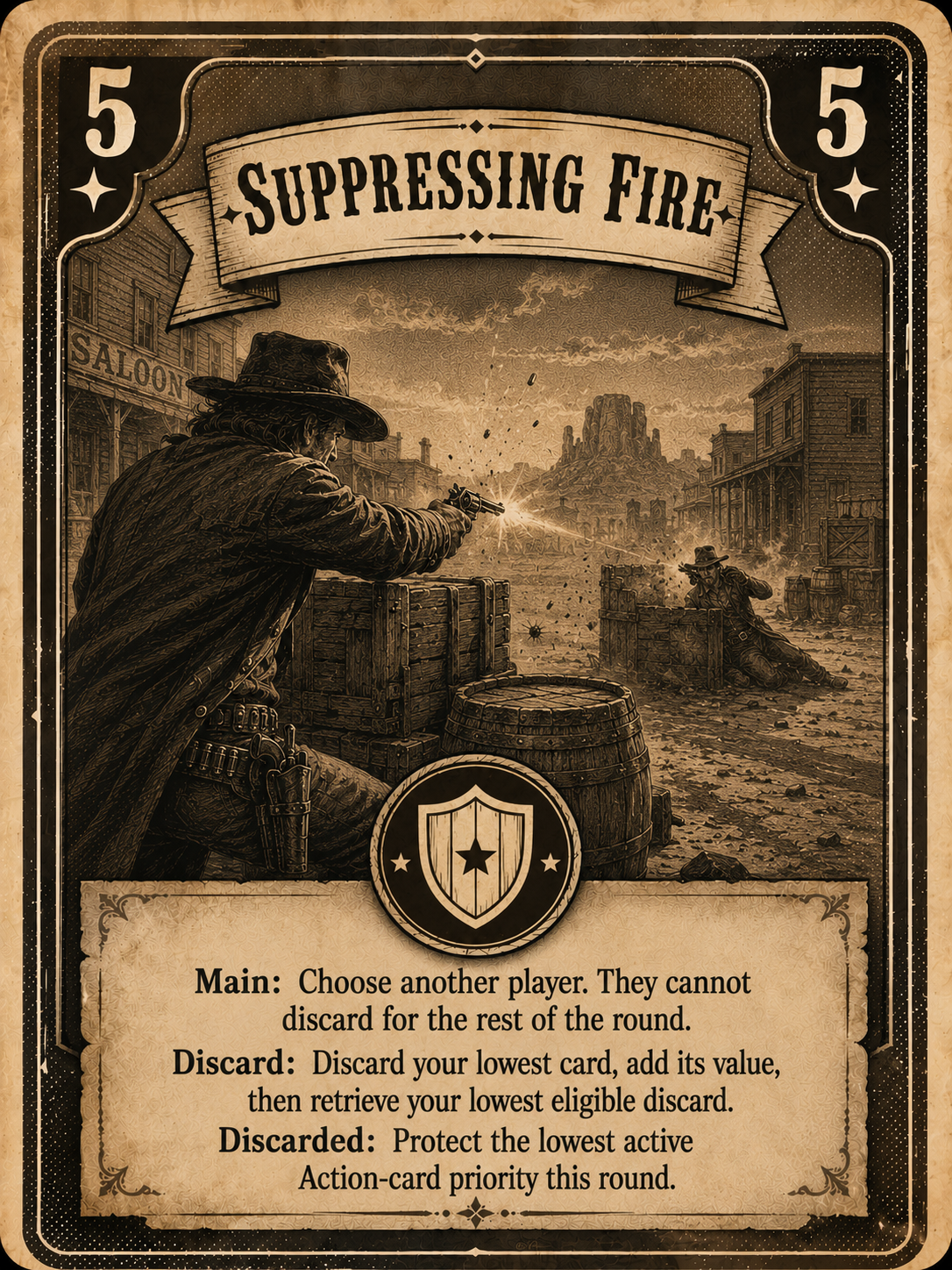
Priority 5
Suppressing Fire
Block discards
Main Effect: choose another living player's active card. That player cannot discard for the rest of the round.
- Discard sequence: discard lowest Action, add its priority to this card's value, retrieve lowest eligible discard, then resolve When Discarded.
- When Discarded: protect every active card tied for lowest printed Action priority unless that player has No Cover.
- You cannot target yourself with the Main Effect.
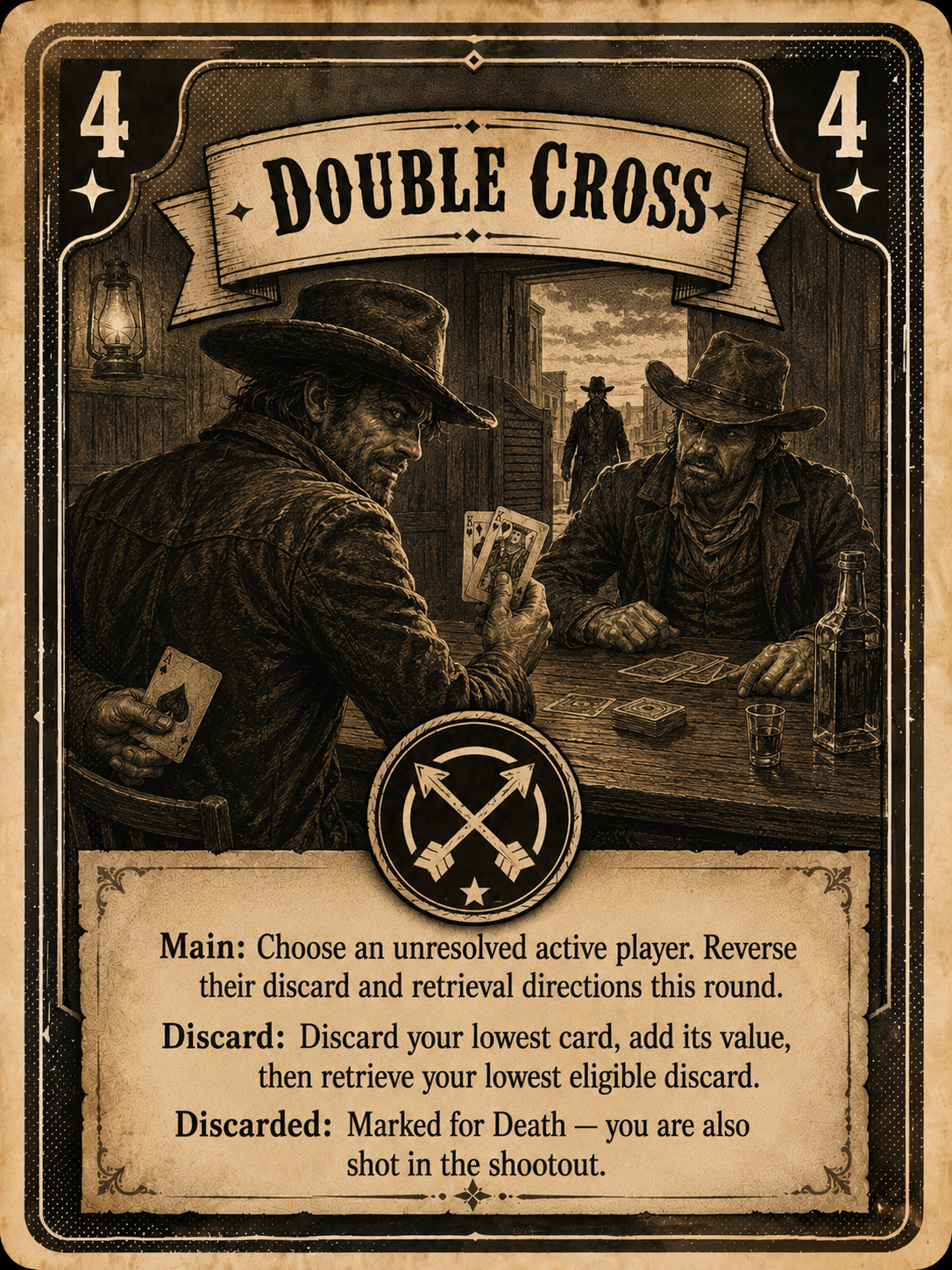
Priority 4
Double Cross
Reverse a sequence
Main Effect: choose this card or another unique, non-disabled active Action card whose sequence is not complete. Reverse that card's discard and retrieval directions for the rest of the round.
- Reload, disabled cards, and completed-sequence cards are illegal targets.
- Discard sequence: discard lowest Action, add its priority to this card's value, retrieve lowest eligible discard, then resolve When Discarded.
- When Discarded: mark yourself for the shootout.
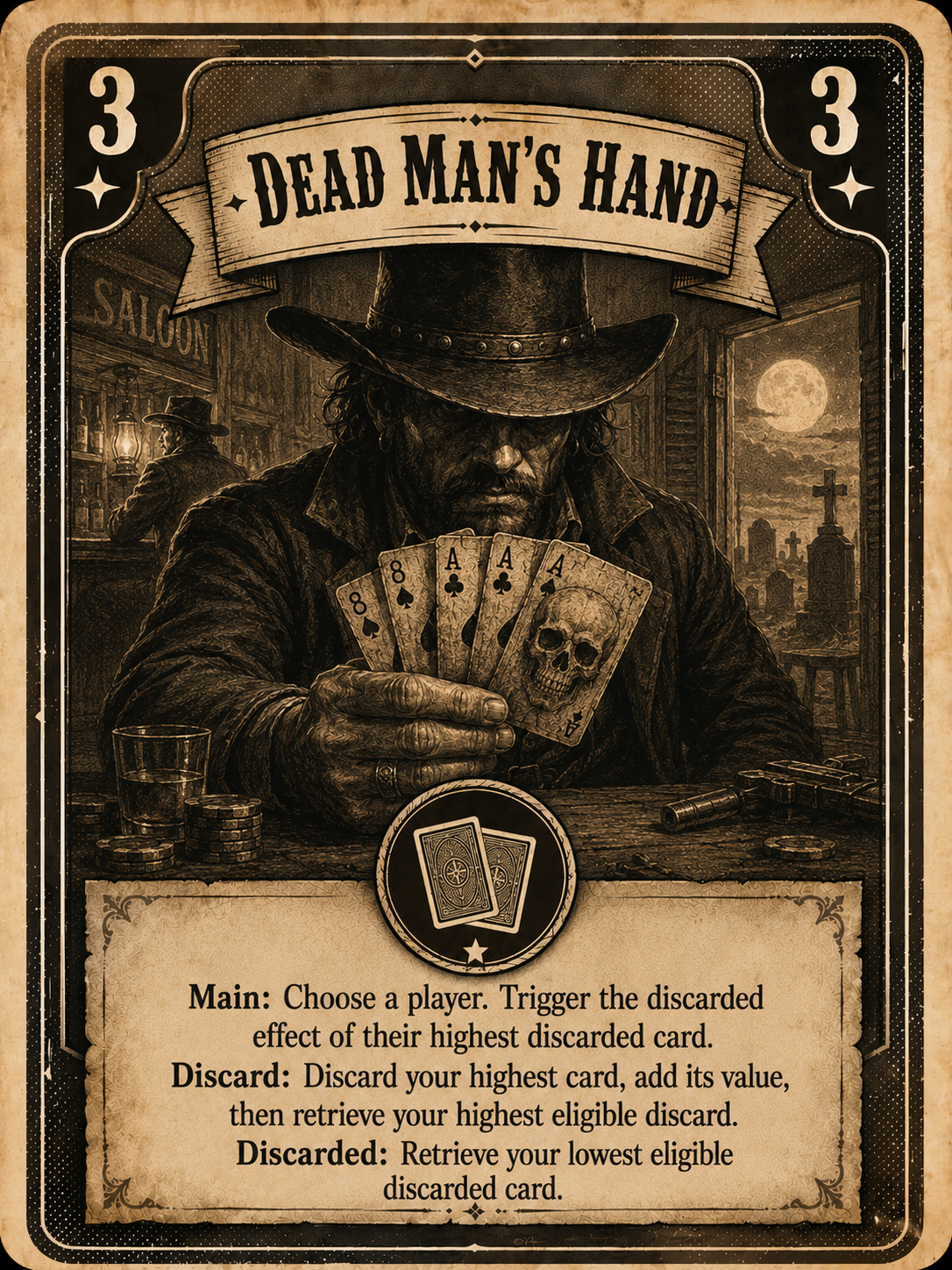
Priority 3
Dead Man's Hand
Trigger a discarded card
Main Effect: choose any active player's card. The game automatically triggers that player's highest discarded Action card's When Discarded effect without moving it.
- Choosing a player with an empty discard pile is legal but does nothing after the choice.
- Discard sequence: discard highest Action, add its priority to this card's value, retrieve highest eligible discard, then resolve When Discarded.
- When Discarded: retrieve your lowest eligible discarded Action, respecting exclusions.
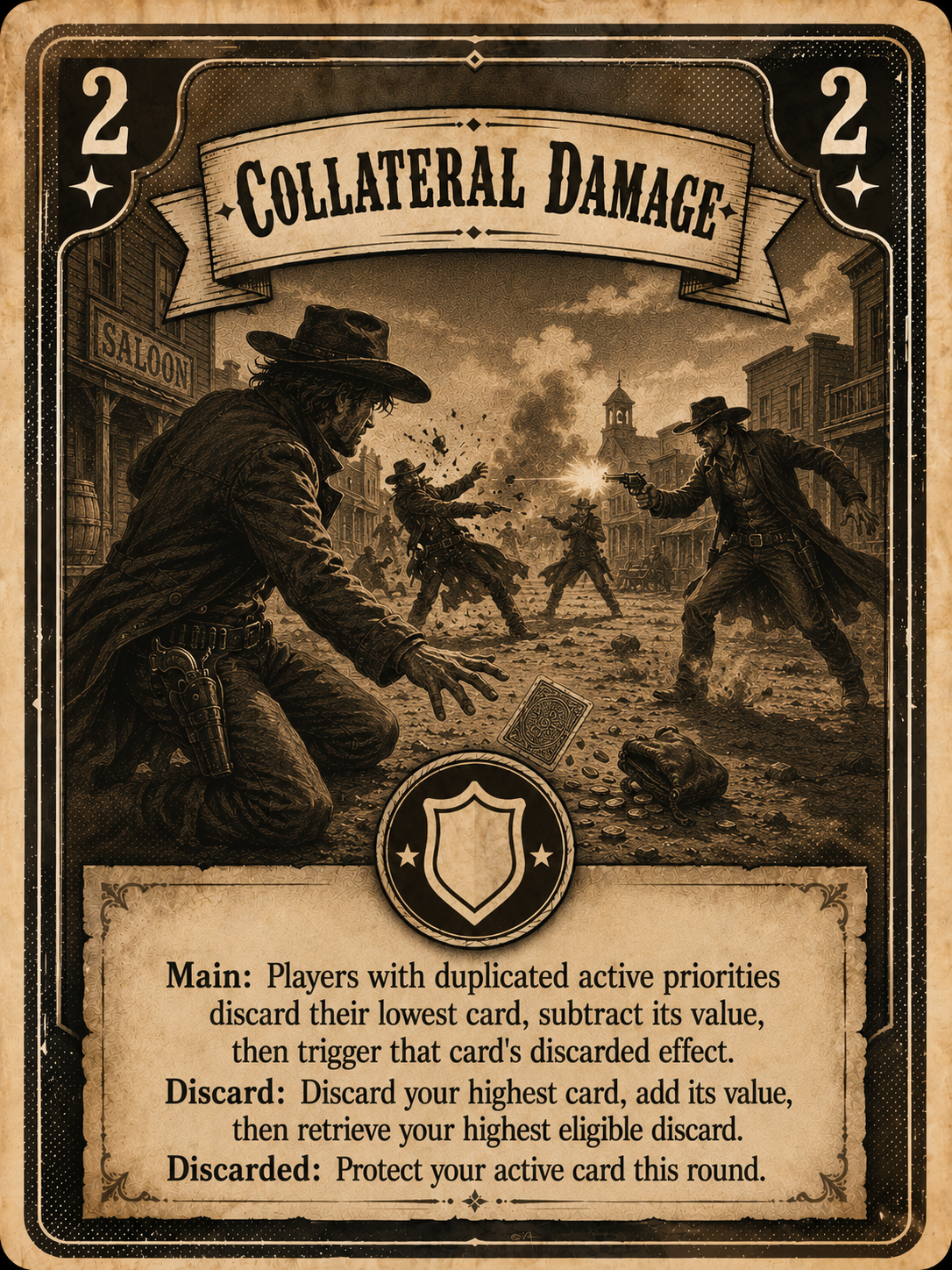
Priority 2
Collateral Damage
Punish disabled cards
Main Effect: snapshot players whose active Action cards were disabled by the reveal-time duplicate rule. In seat order, each eligible unblocked player discards their lowest Action, subtracts that priority from their active current value, and performs no retrieval.
- The value reduction cannot go below 0.
- Discard sequence: discard highest Action, add its priority to this card's value, retrieve highest eligible discard, then resolve When Discarded.
- When Discarded: protect your active card unless No Cover blocks it.
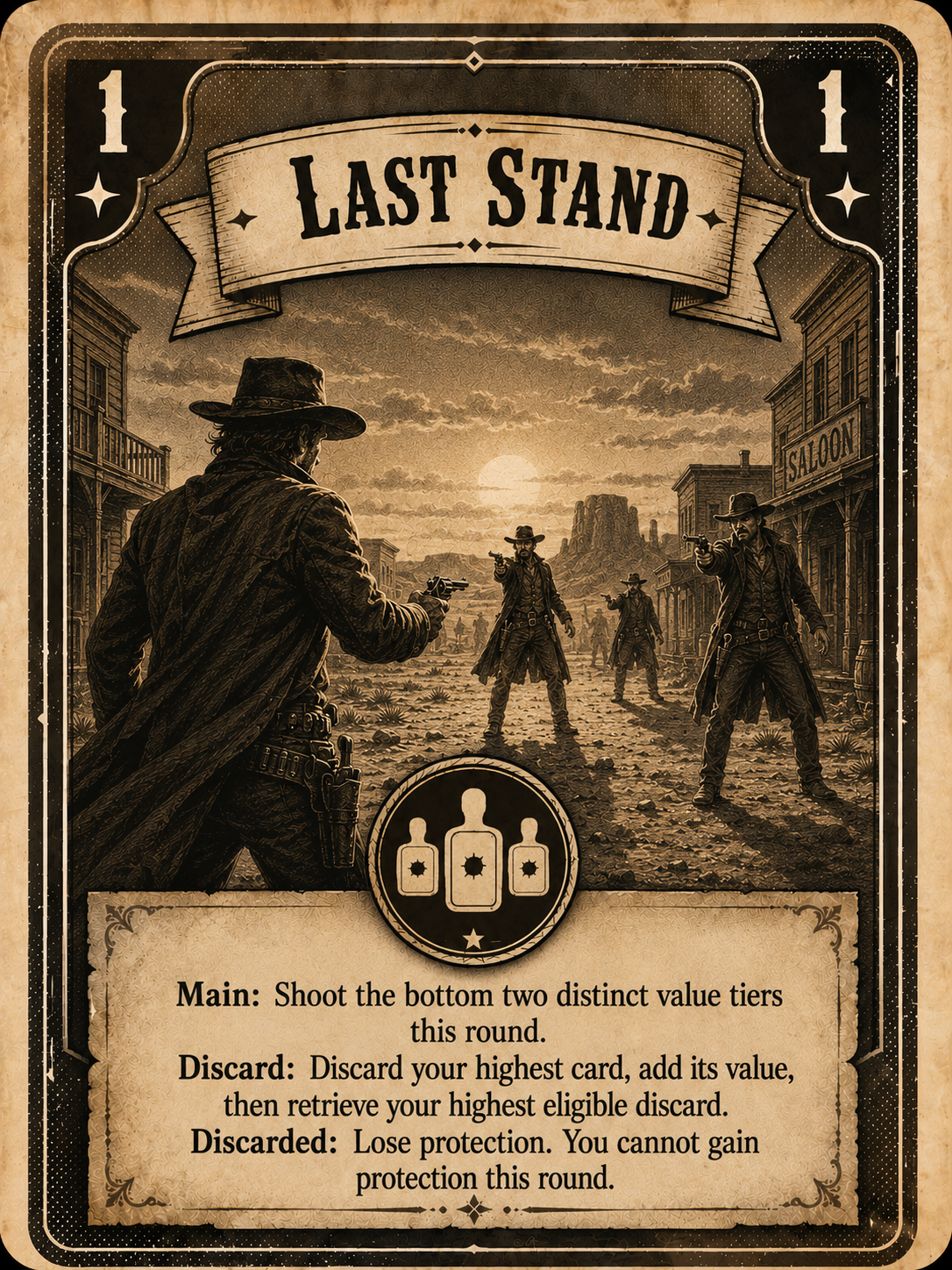
Priority 1
Last Stand
Widen the shootout danger zone
Main Effect: arm Last Stand for this round. During shooting, target the bottom two distinct unprotected current-value tiers instead of only the lowest tier.
- Discard sequence: discard highest Action, add its priority to this card's value, retrieve highest eligible discard, then resolve When Discarded.
- When Discarded: gain No Cover and immediately remove any existing protection on your active card.
- No Cover prevents later Set 5 protection for the rest of the round.
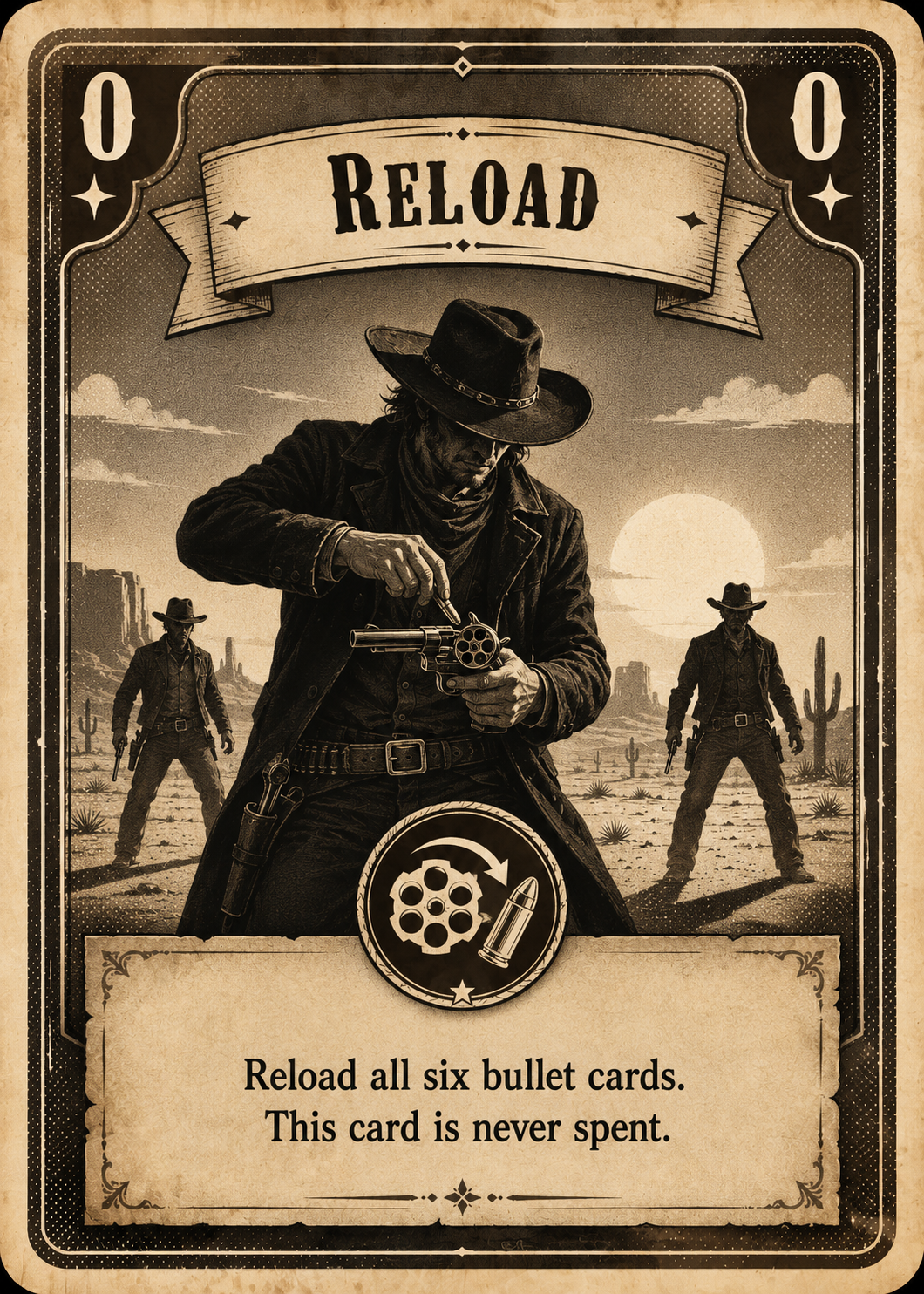
Priority 0
Reload
Non-Action Reload
Every Reload always activates. At cleanup, a successful Reload restores all six Action cards originally owned by the reloading player to hand.
- Reload has no discard sequence and no When Discarded effect.
- Reload is never selected by discard or retrieval helpers.
- Reload does not protect you from shooting.
Card set
Set 6: Blood Money
Ammunition is currency. Buy survival now at the cost of bullets for later rounds and standoffs.
- Duplicates
- Duplicate printed priorities 1–6 cancel all those abilities. Reload always resolves. Duplicates do not replace ordinary shooting.
- Ownership
- Ownership never changes. Paying spends one of the acting player’s own available, unplayed bullets immediately, without activating it. Active cards and Reload cannot be paid. Payments are public; successful Reload restores them.
- Shooting
- Shoot every unprotected card tied at the lowest current value. Value changes do not change printed priority, and protection follows the physical card.
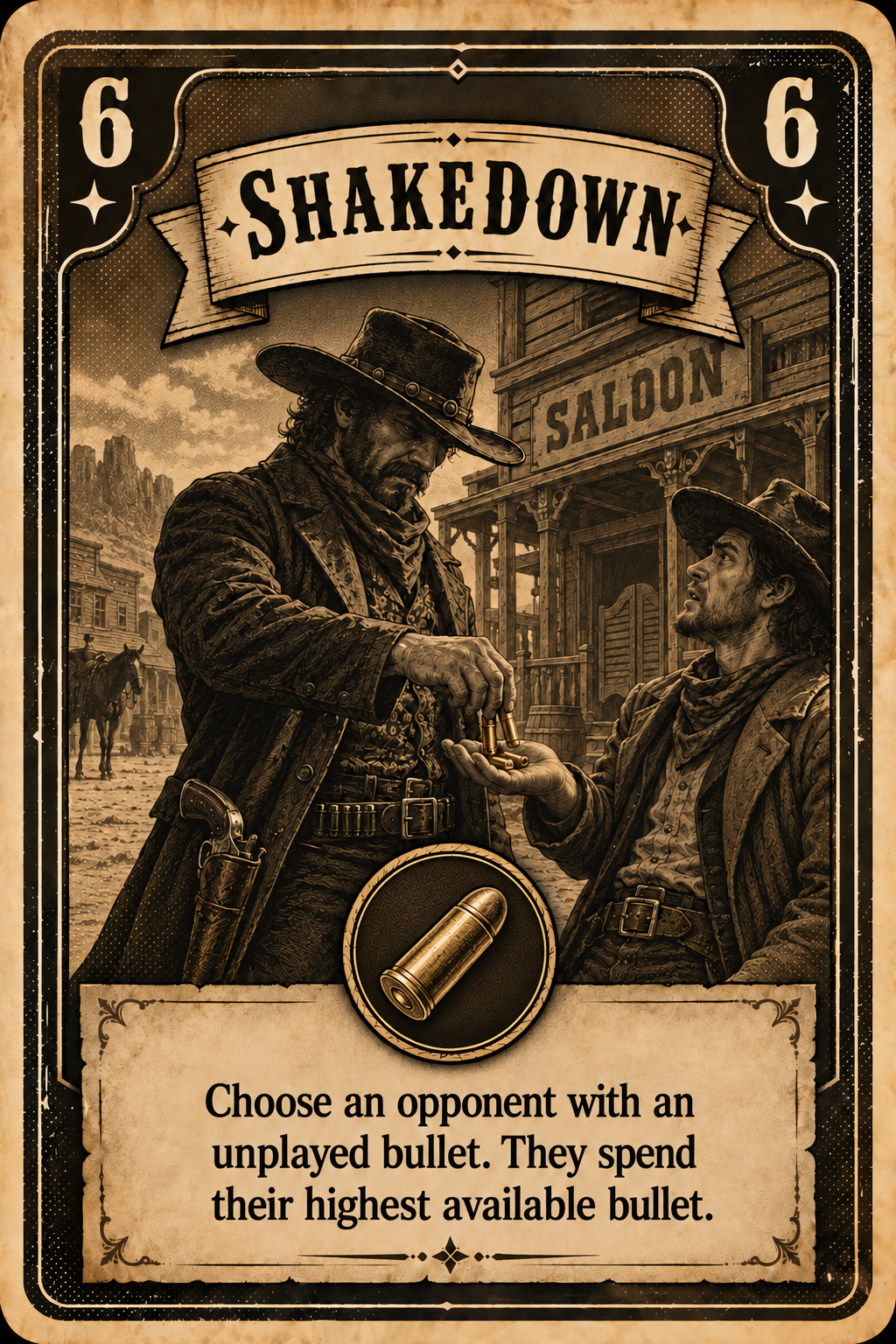
Priority 6
Shakedown
Post-reveal decision
Choose an opponent with an available, unplayed bullet. They spend their highest such bullet.
- The target chooses no bullet: the highest eligible priority is spent automatically. With no eligible opponent, Shakedown does nothing.
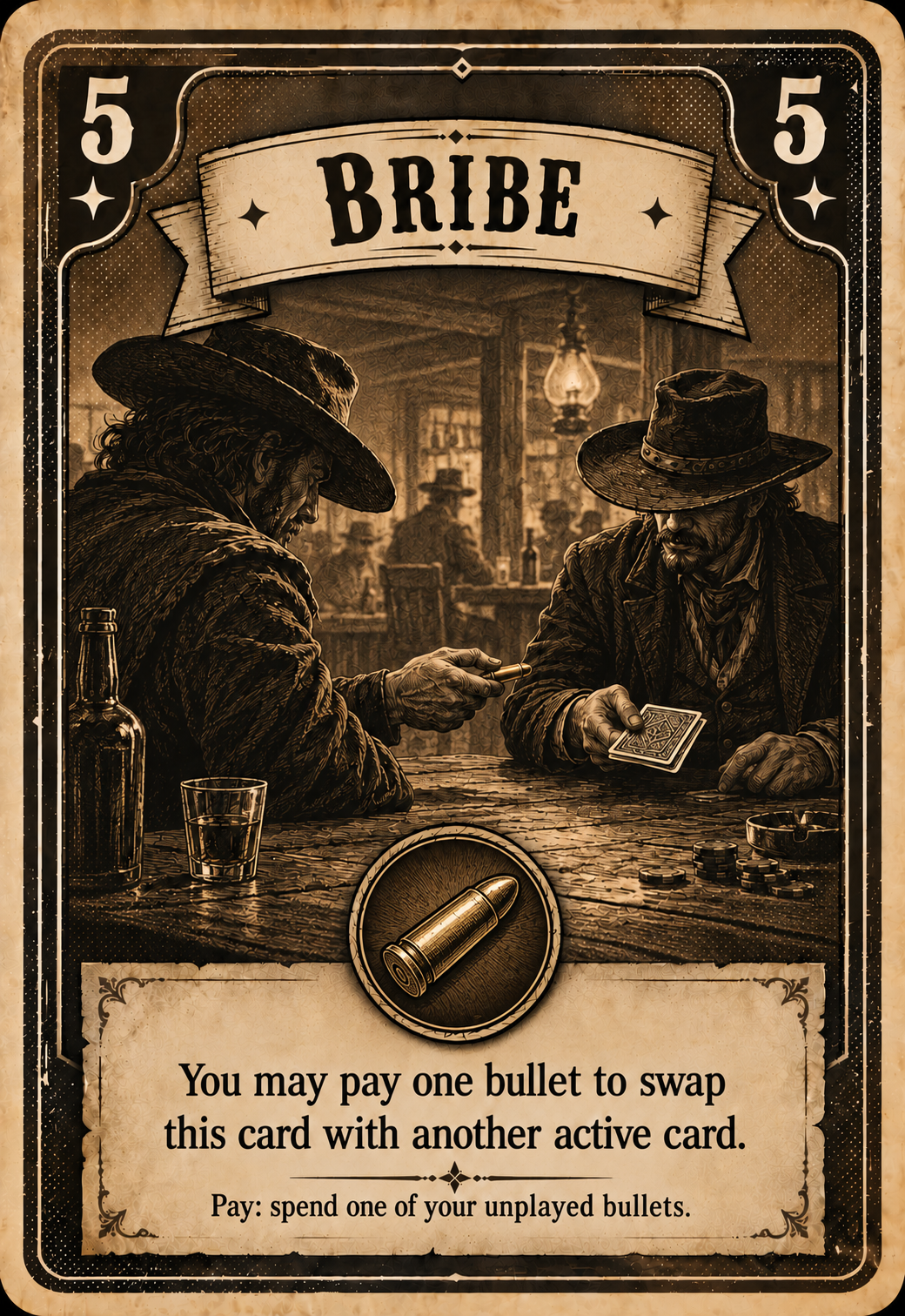
Priority 5
Bribe
Post-reveal decision
You may pay one bullet to swap this physical card with another active card. Ownership and activation status stay unchanged.
- Choose the target and payment together. Previously resolved cards never activate again; acquired lower pending cards resolve for their new controller.
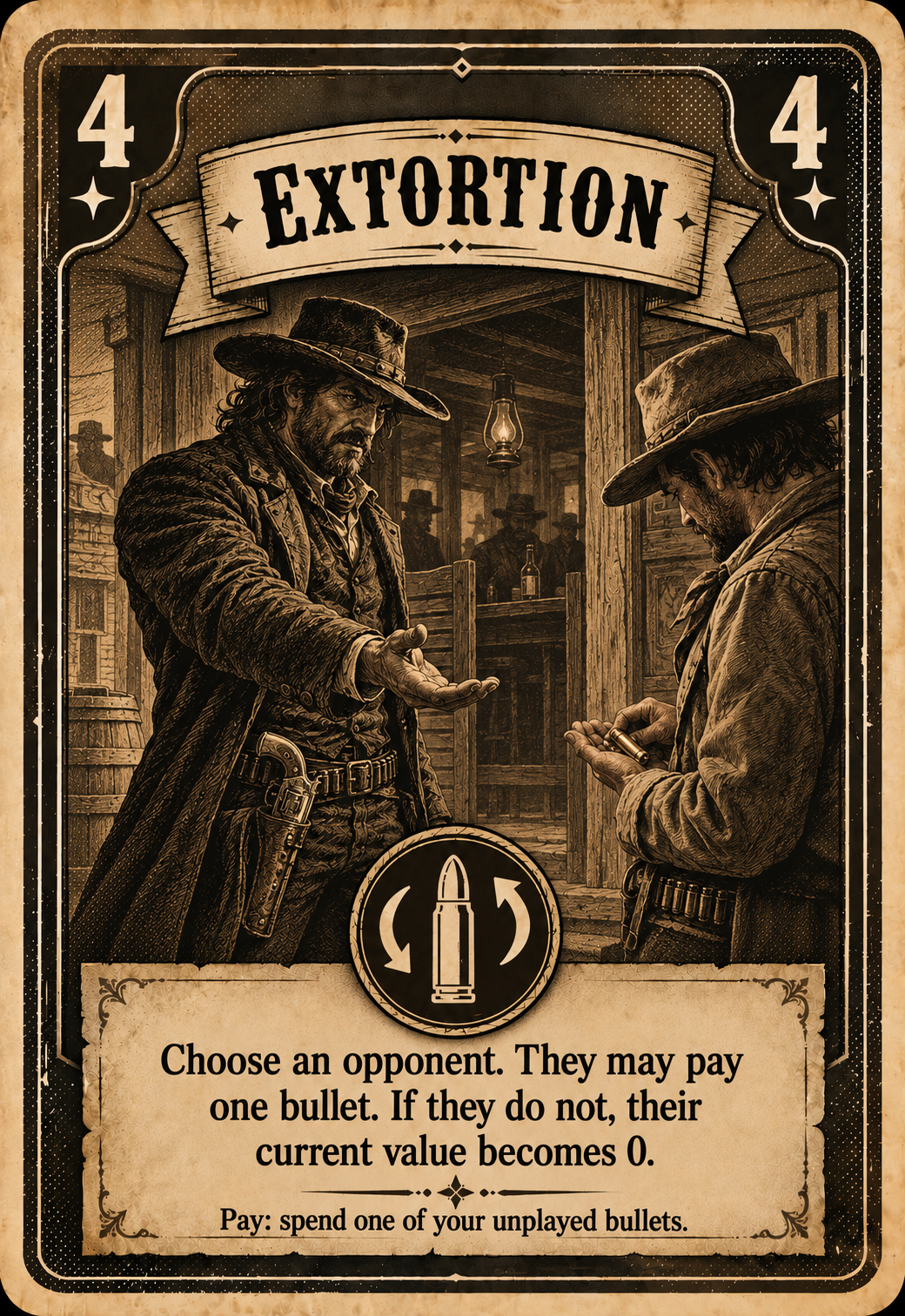
Priority 4
Extortion
Post-reveal decision
Choose an opponent. They may pay one bullet; otherwise their active card’s current value becomes 0.
- The chosen opponent answers the payment decision. If they cannot pay, their value becomes 0 automatically.
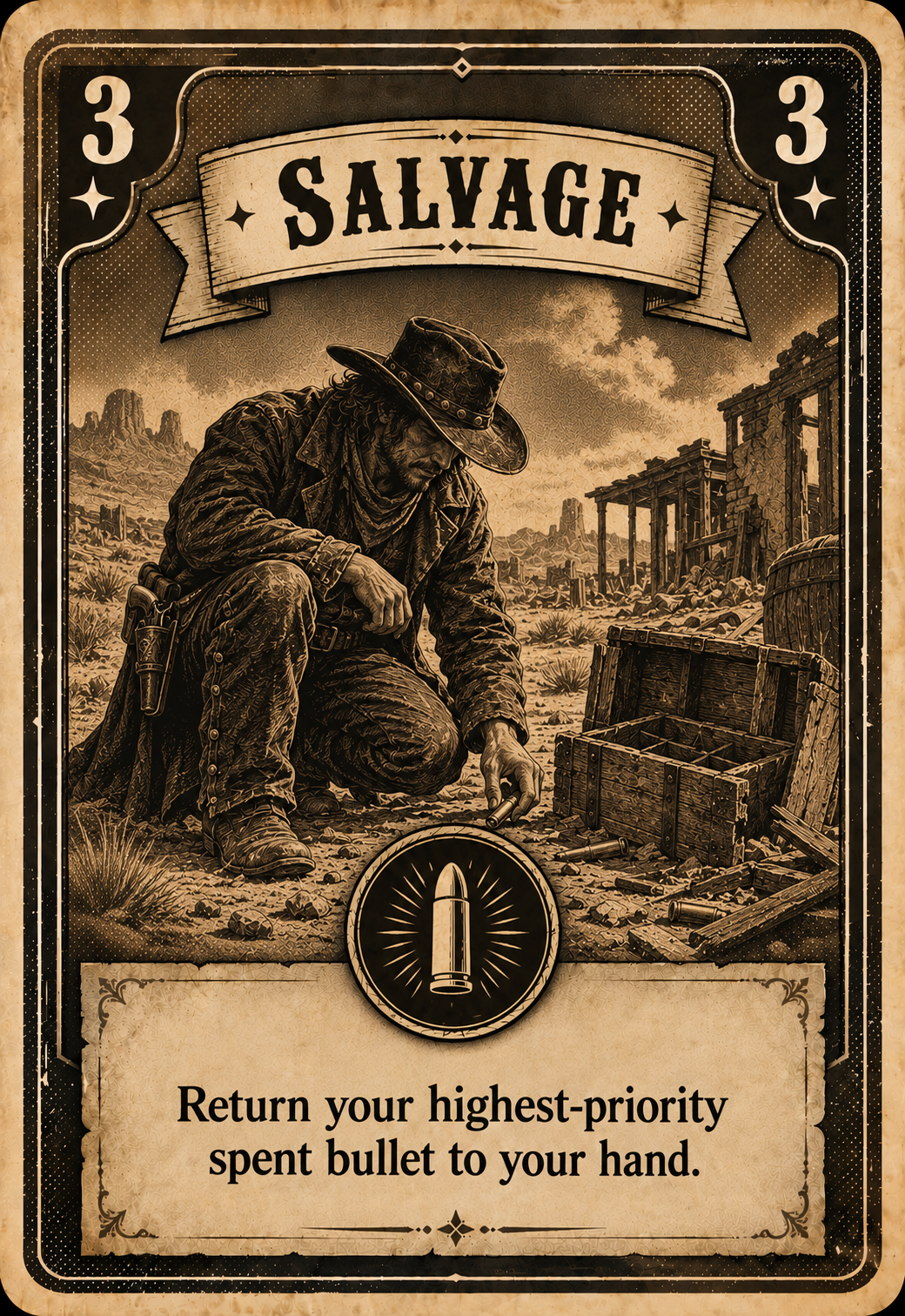
Priority 3
Salvage
Automatic effect
Automatically return your highest-priority spent bullet to your hand.
- Salvage can recover a bullet spent earlier this round. It cannot recover the active Salvage card.
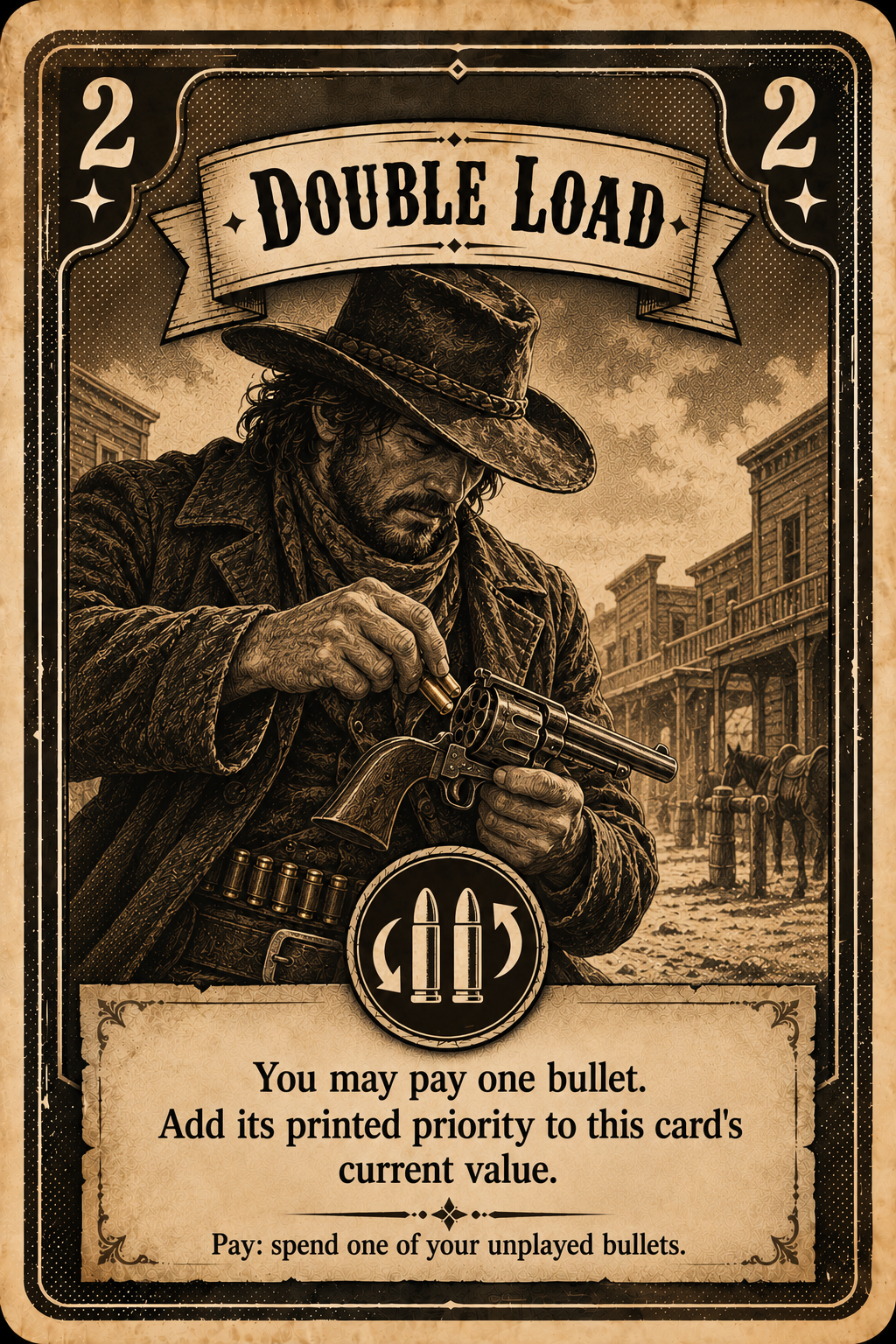
Priority 2
Double Load
Post-reveal decision
You may pay one bullet to add its printed priority to this card’s current value.
- You may decline payment. If no eligible payment exists, the card resolves without its optional effect.
Priority 1
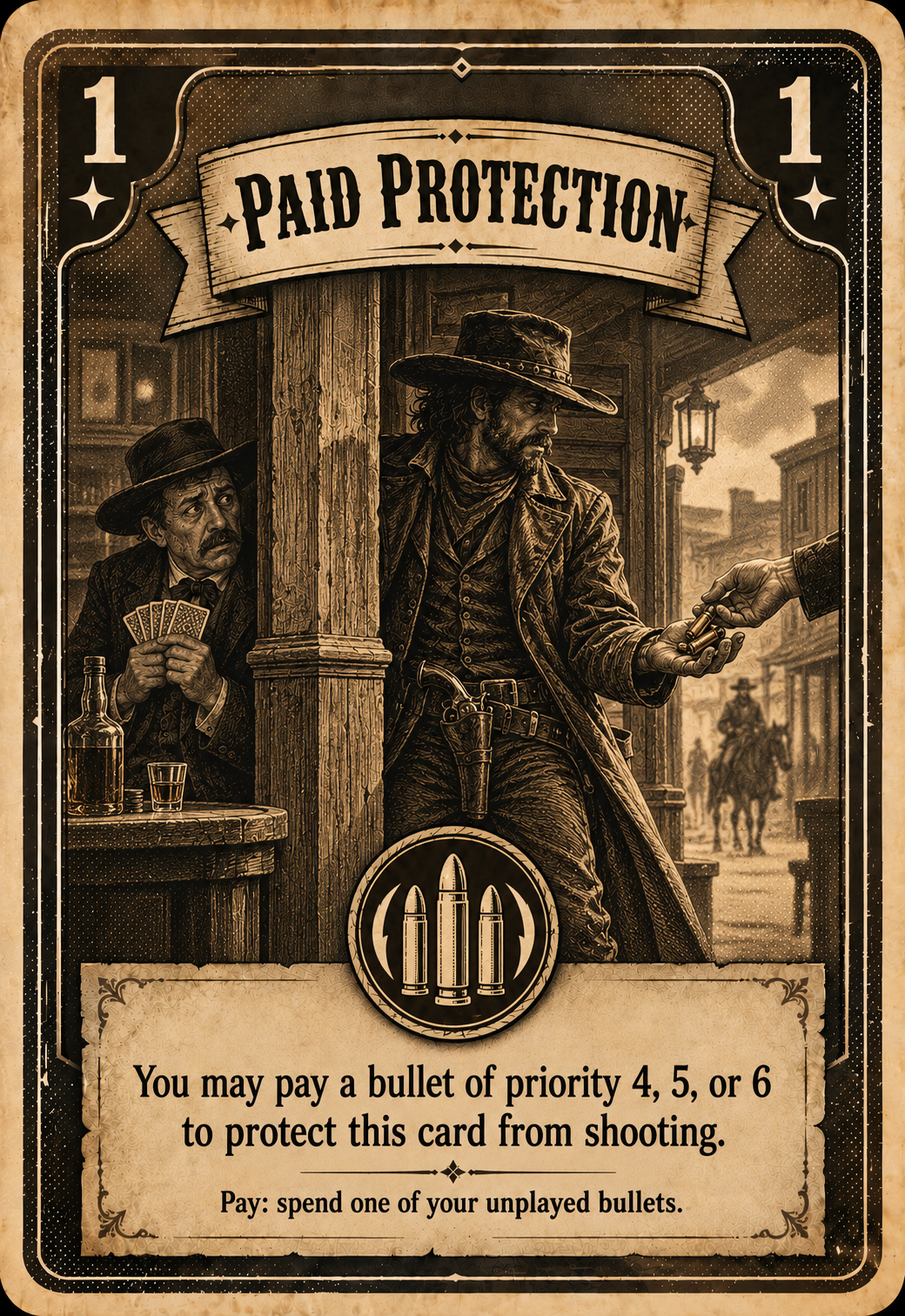
Paid Protection
Post-reveal decision
You may pay a bullet of priority 4, 5, or 6 to protect this physical card from shooting.
- You may decline payment. If no eligible payment exists, the card resolves without its optional effect.
Priority 0
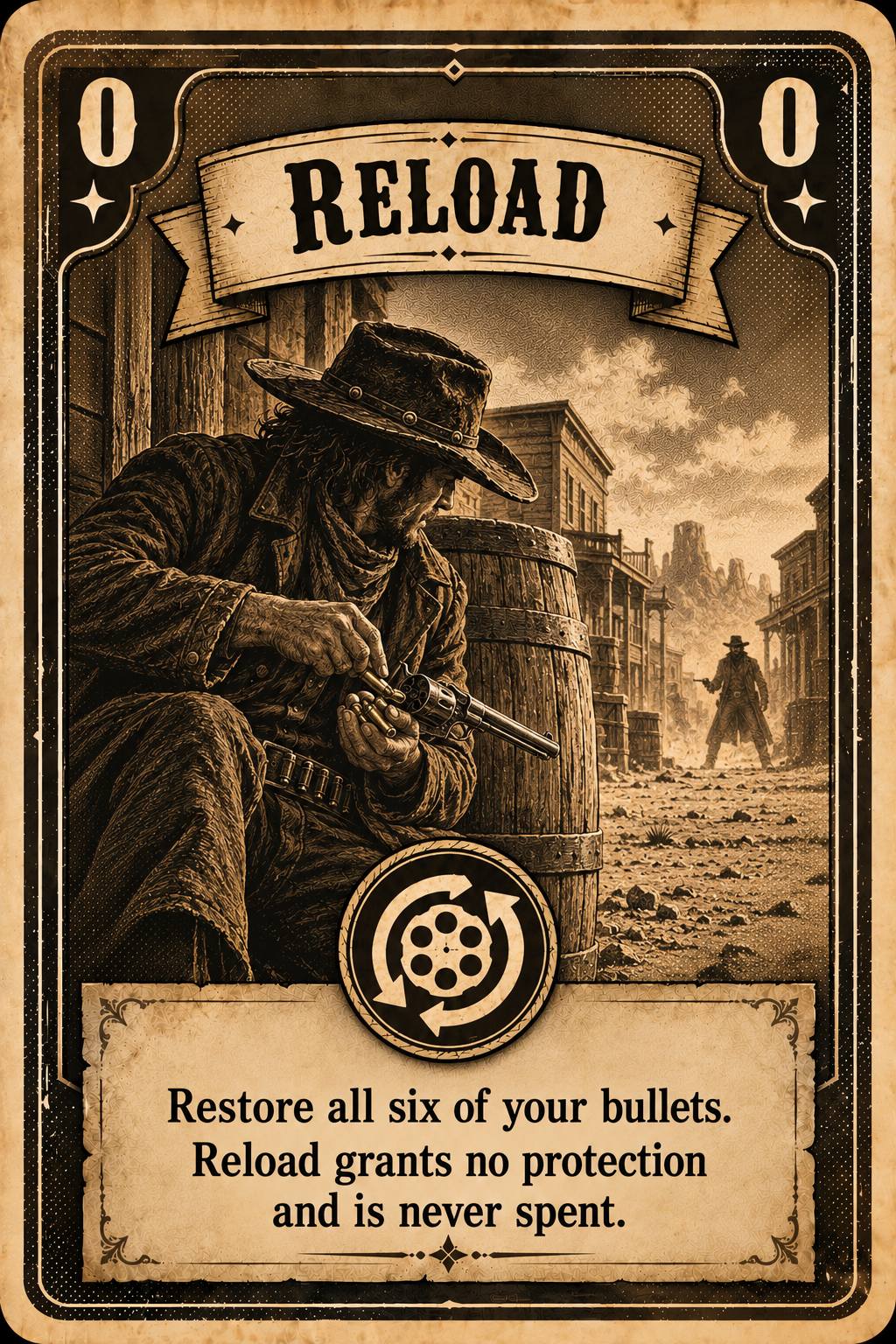
Reload
Automatic effect
Restore all six of your bullets, including payments. Reload grants no protection and is never spent.
- Every Reload resolves, including duplicates. The current controller restores their own six bullets at cleanup.
Online play
Private Rooms
Hosting
Choose Host Game, enter a display name, then share the room code or share link. The host can adjust starting lives and card set in the lobby before starting.
Joining
Choose Join Game, enter a display name and room code, then wait in the lobby. Room codes are case-insensitive. A room supports up to six playable seats.
Spectating
Spectators can watch public board state, revealed cards, discard piles, and the event log. They do not get a hand, cannot submit game commands, and cannot see hidden selections.
Hidden Information
Before reveal, you can see your own chosen card. Other players and spectators only see submitted or not submitted. Card identities become public only after every living player has chosen.
Do not miss these
Edge Cases
- Duplicates usually cancel effects, not players. A duplicated card can still be shot later if it has the lowest unprotected current value.
- Cards activate at most once per round. Swapping into a resolved card never makes it activate again.
- Acquiring a future unresolved card can let that card activate later for its new controller.
- Temporary swaps in Sets 1, 2, and 4 do not change original ownership. Set 3 is the permanent-exchange exception.
- Ammunition persists between standoffs. Dying early can leave you with more bullets for the next standoff.
- There is no gameplay randomness after choices are made. Random card set selection resolves to one concrete set when the host starts the match.
- Set 5 cleanup moving active Action cards to discard does not trigger When Discarded effects.